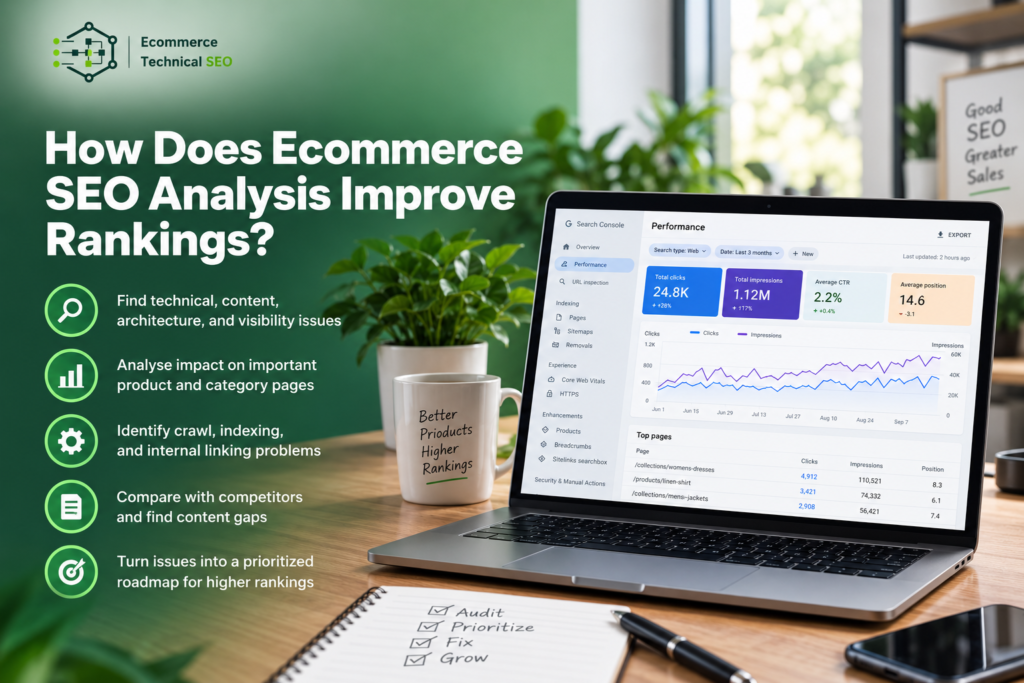

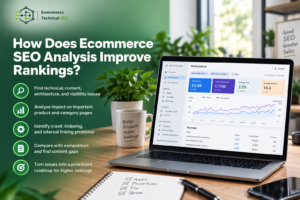
Ecommerce SEO analysis improves rankings by finding the technical, content, architecture, and visibility problems that prevent important product and category pages from performing in search.
The value is not simply finding SEO errors. A useful analysis connects each problem to the pages affected, search demand, commercial value, and the action required to fix it.
For ecommerce websites, this matters because one technical issue can affect hundreds or thousands of URLs.
A filter can create duplicate pages. Poor internal linking can bury profitable categories. Incorrect canonicals can send conflicting signals. Slow templates can affect every product page.
SEO analysis turns these problems into a prioritized roadmap.
Instead of asking, “Why are our rankings down?” you can answer more useful questions:
- Are important pages being crawled?
- Are the correct URLs being indexed?
- Are category pages targeting the right search intent?
- Are internal links supporting commercial pages?
- Are URL parameters creating crawl waste?
- Are competitors covering search needs that your store misses?
- Which SEO fixes have the highest potential business impact?
That is how analysis becomes ranking improvement rather than another SEO report.
What Is Ecommerce SEO Analysis?
Ecommerce SEO analysis is the process of examining how search engines discover, understand, index, and rank an online store.
It combines technical crawling, Search Console data, keyword performance, site architecture, page templates, internal links, structured data, content, and competitor research.
A deeper ecommerce technical SEO audit is often required when a store has large catalogs, faceted navigation, JavaScript, international URLs, or complex product variants.
The analysis should identify both the problem and its ranking consequence.
| SEO area | What analysis checks | Possible ranking impact |
| Crawlability | Links, robots rules, crawl paths | Important pages may not be discovered efficiently |
| Indexation | Canonicals, noindex, duplicate URLs | Valuable URLs may not enter or remain in the index |
| Site architecture | Categories, depth, hierarchy | Search engines may struggle to understand page importance |
| Internal linking | Link paths and anchor context | Commercial pages may receive weak internal support |
| Content | Intent, duplication, relevance | Pages may fail to satisfy target searches |
| Performance | Speed and Core Web Vitals | Poor experience can weaken overall search performance |
| Structured data | Product and breadcrumb information | Search engines may understand products less clearly |
A good analysis therefore looks beyond individual errors.
It studies how different issues interact.
How SEO Analysis Finds Crawlability and Indexation Problems
A page cannot generate meaningful organic rankings if search engines cannot reliably discover and index it.
Yet crawlability and indexation are not the same thing.
A page can be crawlable but not indexed. It can also appear in a sitemap while remaining difficult to discover through normal site navigation.
Understanding crawlability vs indexation in ecommerce SEO helps teams diagnose the correct problem before making changes.
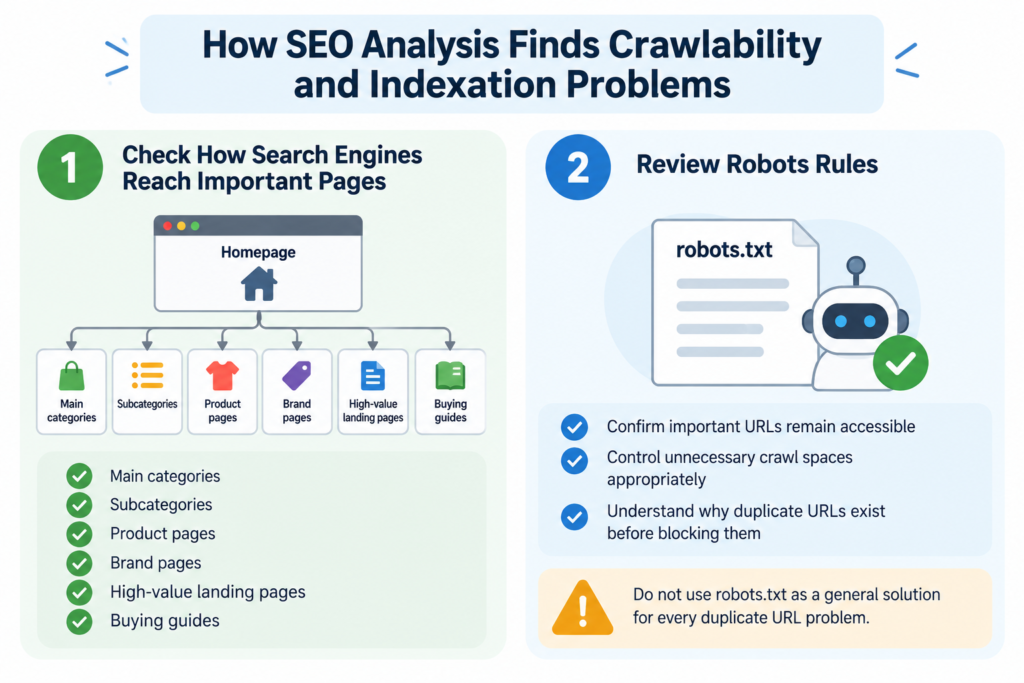
Check How Search Engines Reach Important Pages
Start by examining the path from the homepage to:
- Main categories
- Subcategories
- Product pages
- Brand pages
- High-value landing pages
- Buying guides
Commercial pages should not depend only on XML sitemaps for discovery.
Important URLs should have logical crawlable links within the website.
SEO analysis can uncover pages buried five or six clicks deep, orphan pages, broken navigation paths, and sections with very few internal links.
Review Robots Rules
A robots.txt file can help manage crawler access, but incorrect rules can block important resources or sections.
This is especially risky after migrations, development changes, filter updates, or platform modifications.
Reviewing robots.txt for ecommerce SEO helps confirm that useful URLs remain accessible while unnecessary crawl spaces are controlled appropriately.
Do not use robots.txt as a general solution for every duplicate URL problem.
First understand why those URLs exist.
Ecommerce SEO Analysis Controls URL Parameter Problems
Faceted navigation is one of the biggest differences between ecommerce SEO and SEO for smaller websites.
A category containing filters for size, color, price, brand, availability, style, and sorting can generate thousands of URL combinations.
Some filtered pages may have genuine search value.
Most do not.
For example:
- /shoes?color=black
- /shoes?color=black&size=10
- /shoes?sort=price-low
- /shoes?color=black&size=10&sort=price-low
Without analysis, crawlers can spend significant resources exploring combinations that provide little unique search value.
A proper strategy to control ecommerce URL parameters separates useful search landing pages from utility URLs created only for shoppers.
Decide Which Filtered URLs Deserve Search Visibility
Do not make the decision only because a filter exists.
Evaluate the filtered page against search intent.
| Question | Strong indexable candidate | Weak indexable candidate |
| Is there search demand? | Yes | Little or none |
| Is intent distinct? | Clear commercial intent | Same intent as parent category |
| Is the product set useful? | Stable and relevant | Very small or unstable |
| Can the page be internally linked? | Yes | Only created dynamically |
| Can content be differentiated? | Yes | Mostly duplicated |
| Does it support business goals? | Yes | Limited commercial value |
This creates a more controlled index.
It also reduces competition between similar URLs.
SEO Analysis Strengthens Ecommerce Category Pages
Category pages often have greater ranking potential than individual products because they can satisfy broader commercial searches.
A page selling many running shoes can target “men’s running shoes,” while individual products target specific brand, model, size, and feature searches.
But category pages commonly suffer from weak internal support.
SEO analysis identifies where navigation, breadcrumbs, product pages, supporting content, and related categories can strengthen important commercial destinations.
A planned approach to internal linking for ecommerce category pages improves discovery while showing clearer relationships between products and categories.
Measure Internal Link Depth, Not Just Link Count
Having 100 internal links does not automatically make a page important.
Context matters.
Analyze:
- Where links come from
- How deep the source page is
- Whether anchor text describes the destination
- Whether stronger pages support priority categories
- Whether products link back to their parent categories
- Whether related categories connect naturally
An important category hidden behind filters should not receive the same structural treatment as a temporary sorting URL.
SEO analysis exposes that difference.
Ecommerce SEO Analysis Matches Pages With Search Intent
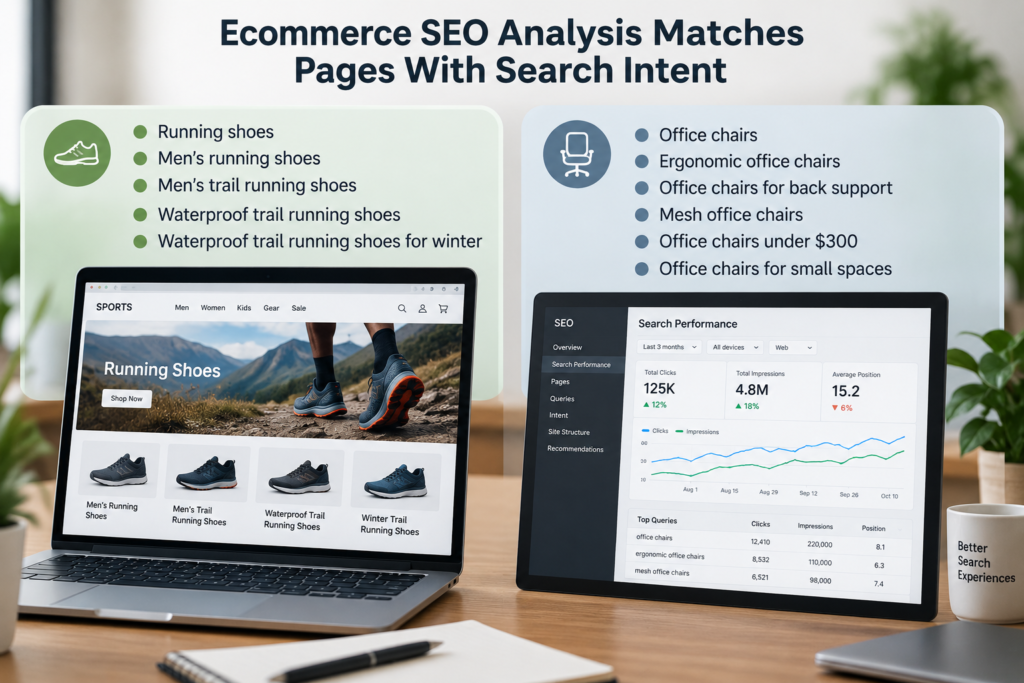
Technical health creates the foundation for ranking, but it does not guarantee relevance.
The next step is determining whether each indexable page answers a useful search need.
An ecommerce store may have several pages competing for closely related searches.
For example:
- Running shoes
- Men’s running shoes
- Men’s trail running shoes
- Waterproof trail running shoes
- Waterproof trail running shoes for winter
These searches belong to the same topic, but the intent becomes more specific.
Each page should exist because it serves a meaningful user need, not because another keyword variation was found.
Use Query Drift to Build Better Search Paths
Query drift happens as the shopper changes or narrows the original need.
Someone searching “office chairs” may move toward:
- Ergonomic office chairs
- Office chairs for back support
- Mesh office chairs
- Office chairs under $300
- Office chairs for small spaces
SEO analysis should identify these natural changes in intent.
The store can then support them through useful subcategories, selected facets, product collections, comparison content, and buying guides.
This is more effective than creating thin pages for every possible phrase.
Use Fan-Out Queries Without Creating Thin Content
AI search systems can expand a complex query into multiple related questions or subtopics.
That makes broad topical coverage useful.
However, the goal is not to create a separate page for every possible fan-out query.
Instead, make each page complete enough to answer the most relevant questions surrounding its main intent.
For this article, useful related questions include:
- What does ecommerce SEO analysis include?
- How does an SEO audit improve rankings?
- How do crawl issues affect ecommerce SEO?
- How does indexation affect product visibility?
- Why do URL parameters cause problems?
- How should ecommerce SEO issues be prioritized?
- Which SEO metrics should be measured after fixes?
These questions strengthen the central topic.
A section about social media advertising would dilute the intent because it does not directly explain how ecommerce SEO analysis improves organic rankings.
Competitor Analysis Shows Where Ranking Opportunities Exist
SEO analysis should not study your website in isolation.
Competitors reveal what Google currently rewards for important commercial searches.
Do not simply compare domain authority or total keyword numbers.
Study the actual pages competing with your categories and products.
Look for differences in:
- Page type
- Category structure
- Internal linking
- Search intent
- Product range
- Supporting content
- Structured data
- Page experience
- Backlink strength
- Brand and topical coverage
Competitive analysis becomes especially valuable when your page is technically healthy but remains below stronger results.
Look for Missing Entities and Information
A page can target the correct keyword and still provide incomplete information.
Suppose competitors ranking for “commercial espresso machines” repeatedly cover:
- Boiler type
- Group heads
- Voltage
- Daily capacity
- Installation
- Water connection
- Warranty
If your category only contains product cards, those missing concepts may indicate an information gap.
Do not copy competitors.
Identify the information shoppers need to make a better decision, then provide clearer and more useful coverage.
Prioritize SEO Problems by Ranking and Revenue Impact
One of the biggest mistakes in ecommerce SEO is treating every crawler warning as equally important.
A missing meta description on an old product is different from canonical errors affecting 3,000 revenue-driving category URLs.
Analysis should create priorities.
| Priority | Example issue | Recommended action |
| Critical | Important categories blocked or non-indexable | Fix immediately |
| High | Large-scale canonical or parameter problem | Investigate and resolve |
| High | Priority categories are orphaned or deeply buried | Improve architecture and links |
| Medium | Duplicate titles across active products | Fix at template or page level |
| Medium | Weak category content | Improve based on search intent |
| Low | Minor issue on discontinued low-value URL | Fix only if resources allow |
This business-first approach prevents teams from spending weeks fixing low-impact warnings.
A structured technical SEO audit should therefore include prioritization, not just an export containing hundreds of URLs.
Analyze Core Web Vitals and Ecommerce Templates
Performance analysis should focus on templates rather than treating every slow URL as a separate problem.
If one product template contains oversized images, excessive JavaScript, or layout shifts, thousands of products may inherit the same issue.
Category templates can have similar problems from product grids, filtering scripts, banners, review widgets, and third-party apps.
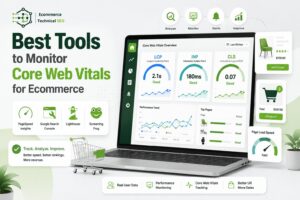
Reviewing Core Web Vitals for ecommerce helps identify whether performance problems are isolated or template-wide.
Fixing one template-level cause can improve many URLs at once.
That is another reason analysis matters before implementation.
Combine Crawling Data With Search Performance Data
A crawler explains what exists technically.
Search Console explains how Google is interacting with your pages.
Analytics and ecommerce data explain what those visits are worth.
The strongest analysis combines these datasets.
| Data source | What it can reveal |
| Screaming Frog | Status codes, canonicals, depth, links, directives, duplicate elements |
| Google Search Console | Queries, impressions, clicks, indexing signals |
| Analytics | Organic landing-page engagement and conversions |
| Ecommerce platform | Revenue, inventory, product and category value |
| Keyword tools | Demand, ranking gaps and competitors |
For example, a crawler may find 200 weakly linked categories.
Search Console may show that 20 already receive strong impressions.
Revenue data may show that five produce high-margin sales.
Those five become an obvious priority.
For large stores, specialist ecommerce SEO tools can make this comparison easier, but tools should support the decision rather than replace it.
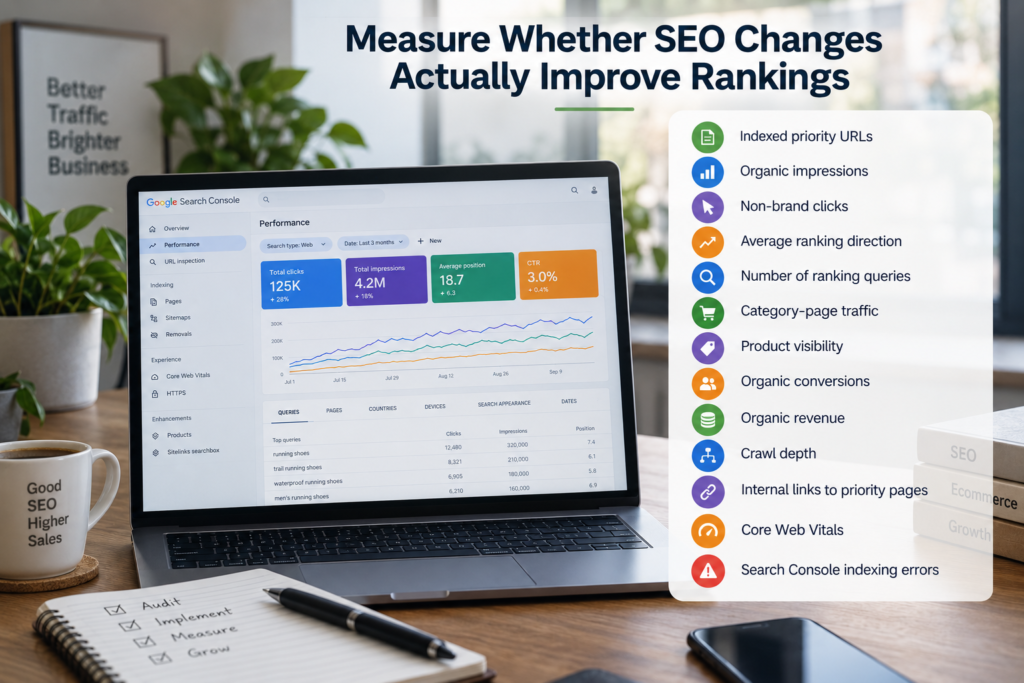
Measure Whether SEO Changes Actually Improve Rankings
An audit is incomplete if nobody measures what happens afterward.
Record a baseline before major changes.
Then monitor the same URL groups after implementation and recrawling.
Useful SEO performance indicators include:
- Indexed priority URLs
- Organic impressions
- Non-brand clicks
- Average ranking direction
- Number of ranking queries
- Category-page traffic
- Product visibility
- Organic conversions
- Organic revenue
- Crawl depth
- Internal links to priority pages
- Core Web Vitals
- Search Console indexing errors
Do not judge success from one keyword.
Ecommerce visibility often improves across groups of related searches rather than through one dramatic ranking movement.
Stores experiencing persistent indexing problems can also investigate recurring coverage problems through a focused Google Search Console error review.
How Often Should You Run Ecommerce SEO Analysis?
A full audit does not need to happen every week.
However, ecommerce websites change constantly.
Products disappear. Categories launch. filters change. Developers deploy code. Apps add scripts. Merchandising teams create new landing pages.
Run deeper analysis before or after major events such as:
- Site migrations
- Platform changes
- Large catalog expansions
- Navigation redesigns
- Faceted-navigation changes
- International expansion
- Major traffic declines
Smaller recurring crawls can then identify new technical problems before they spread across the catalog.
The larger and more dynamic the store, the more useful ongoing monitoring becomes.
How Does Ecommerce SEO Analysis Improve Rankings in Practice?
Ecommerce SEO analysis improves rankings by turning an unclear performance problem into specific, measurable actions.
The practical sequence is simple:
- Identify important commercial URLs.
- Confirm they can be crawled.
- Confirm the right versions can be indexed.
- Control duplicate and parameter URLs.
- Strengthen site architecture and internal links.
- Match categories and products with search intent.
- Compare coverage with ranking competitors.
- Fix high-impact problems before low-value warnings.
- Measure rankings, traffic, conversions, and revenue after implementation.
The goal is not a perfect SEO health score.
The goal is to make your most valuable pages easier to discover, understand, index, and rank.
That is what turns ecommerce SEO analysis into organic growth.
Run a Screaming Frog Technical SEO Audit Before Scaling Content or Backlinks
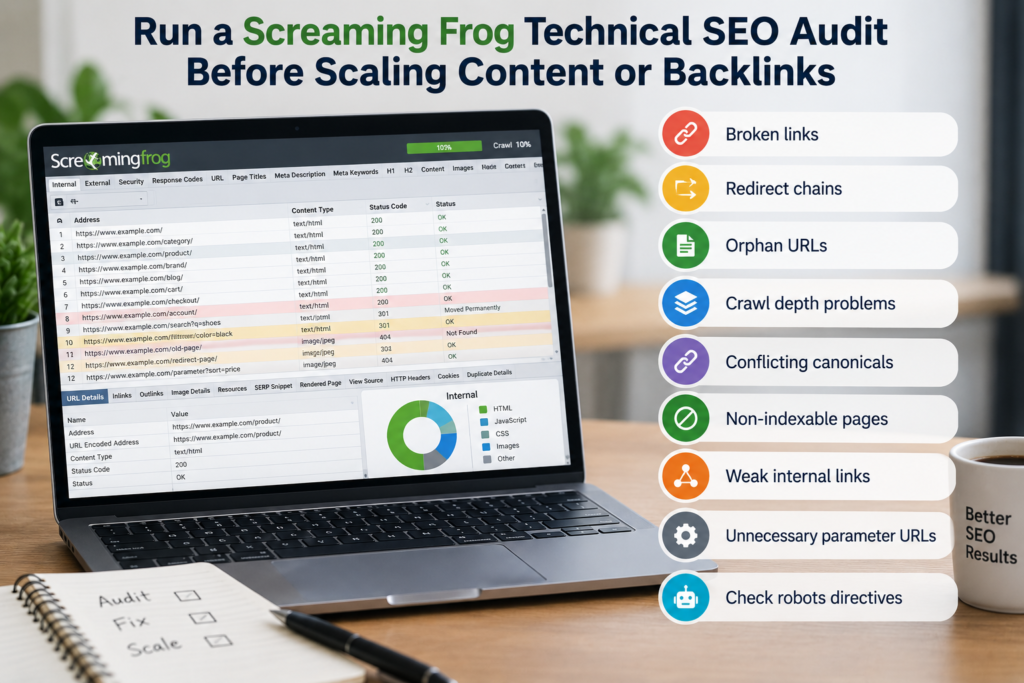
Before investing more budget into content or backlinks, use Screaming Frog to understand what search engines can actually reach across your store.
A Screaming Frog audit before scaling ecommerce SEO can uncover broken links, redirect chains, orphan URLs, crawl depth problems, conflicting canonicals, non-indexable pages, weak internal links, and unnecessary parameter URLs.
The crawl should then be combined with Search Console, sitemap, performance, and commercial data. This helps separate technical noise from issues that can affect important categories, products, organic traffic, and revenue.
Robots directives should also be checked carefully during the audit. Using reliable robots.txt testing tools for ecommerce SEO can help confirm that important pages and resources are not being blocked unintentionally.
At E-commerce Technical SEO, the focus is not simply generating crawler exports. The goal is to understand what each issue means for the store and determine what should be fixed first.
For stores with complex architecture, large catalogs, or ongoing ranking problems, working with an experienced ecommerce SEO consultant can also help connect technical findings with content, internal linking, indexation, and commercial priorities.
Our technical SEO specialists work with ecommerce store owners, marketing teams, developers, and agencies to turn technical findings into practical SEO priorities.
Run the technical analysis first. Then scale content, internal linking, backlinks, and site expansion on a stronger foundation.