

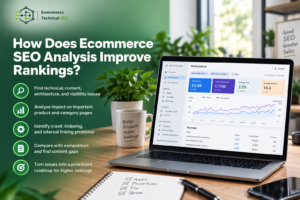
Ecommerce SEO consultants increase online sales by helping the right products and categories appear when shoppers are actively searching for them.
The work goes beyond ranking more keywords. A consultant identifies technical barriers, matches search demand with the correct pages, improves product visibility, strengthens category pages, and measures whether organic visitors actually become customers.
For ecommerce stores, this matters because technical problems can affect hundreds or thousands of URLs at once. A small issue with filters, templates, internal links, product variants, or indexing can limit visibility across an entire catalog.
The goal is therefore not simply more organic traffic.
It is more qualified organic traffic reaching pages that can generate revenue.
What Does an Ecommerce SEO Consultant Actually Do?
An ecommerce SEO consultant finds the SEO problems and growth opportunities that have the greatest effect on product discovery, rankings, traffic, conversions, and organic revenue.
Instead of treating every SEO issue equally, the consultant prioritizes work based on commercial impact.
| SEO area | What the consultant improves | Search impact | Sales impact |
| Crawlability | Navigation, robots rules, crawl paths | Important pages become easier to discover | More products can compete in search |
| Indexation | Canonicals, duplicates, URL control | Google indexes stronger URLs | Less ranking signal is wasted |
| Category SEO | Content, intent, internal links | Commercial pages rank for buying searches | More qualified category traffic |
| Product SEO | Content, schema, product information | Individual products gain visibility | More product-page visits |
| Performance | Speed and Core Web Vitals | Better page experience | Less friction before purchase |
| Measurement | GSC, analytics and revenue data | Better SEO decisions | Investment moves toward profitable pages |
A useful consultant starts by understanding what the store sells, which pages matter commercially, and where organic search currently loses opportunities.
For larger stores, that normally begins with an ecommerce technical SEO audit rather than immediately publishing more content.
Ecommerce SEO Starts With Search Intent and Revenue
Not every keyword deserves the same SEO investment.
Someone searching for “how to choose running shoes” is researching. Someone searching for “men’s waterproof trail running shoes” is much closer to buying.
An ecommerce SEO consultant maps these different searches to suitable page types.
Match the Query With the Correct Page
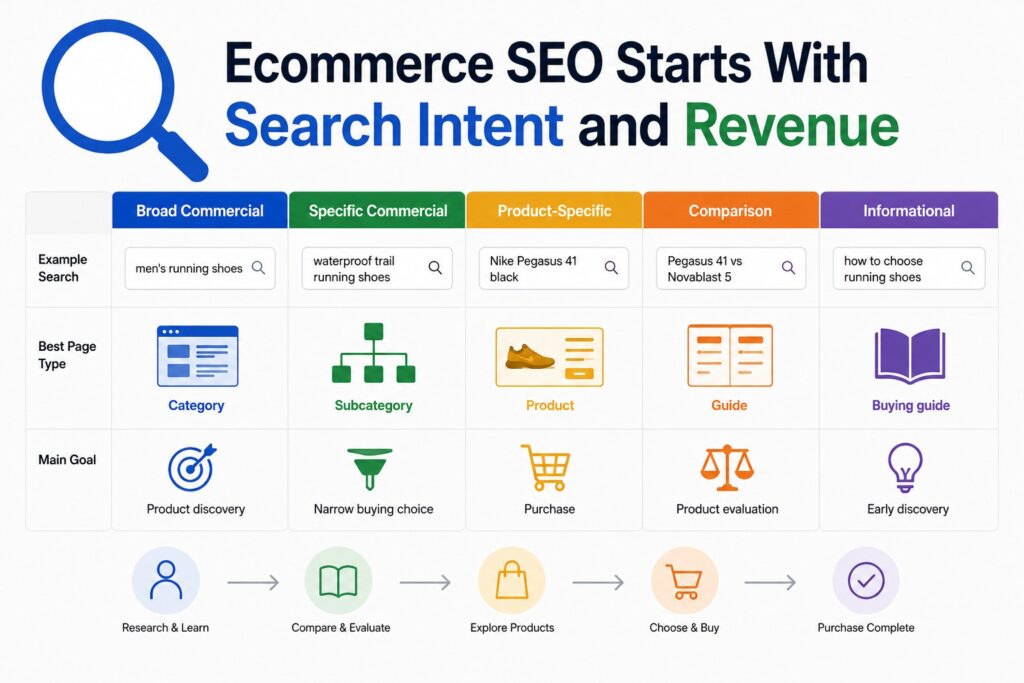
A practical keyword map may look like this:
| Search type | Example | Best page type | Main goal |
| Broad commercial | men’s running shoes | Category | Product discovery |
| Specific commercial | waterproof trail running shoes | Subcategory | Narrow buying choice |
| Product-specific | Nike Pegasus 41 black | Product | Purchase |
| Comparison | Pegasus 41 vs Novablast 5 | Guide | Product evaluation |
| Informational | how to choose running shoes | Buying guide | Early discovery |
This prevents several pages from competing for the same search intent.
It also creates a clearer customer journey.
Informational content attracts research demand. Buying guides help shoppers compare. Categories capture commercial searches. Product pages satisfy highly specific purchase intent.
A consultant connects these page types instead of optimizing them separately.
Consultants Fix Crawlability and Indexation Problems
A product cannot generate organic sales if search engines struggle to discover or index its URL.
This becomes difficult on ecommerce sites because filters, sorting options, tracking parameters, product variants, pagination, internal search pages, and session URLs can create huge numbers of crawlable addresses.
Understanding crawlability versus indexation is therefore an important first step.
Crawling means a search engine can reach a URL.
Indexation means that URL may be stored and considered for search results.
The two should not be treated as the same problem.
Control Low-Value Ecommerce URLs
A consultant may review:
- Filter and faceted navigation URLs
- Sort parameters
- Tracking parameters
- Search-result URLs
- Product variants
- Pagination
- Canonical tags
- XML sitemaps
- Noindex directives
- Internal crawl paths
Poorly controlled faceted navigation can create extremely large URL spaces and slow discovery of useful pages. Google specifically warns that parameter-based facets can lead to overcrawling and slower discovery crawling.
Stores with this problem should review how they control ecommerce URL parameters instead of allowing every possible filter combination to become a search-engine target.
The consultant may also review robots.txt for ecommerce SEO when crawl access needs tighter control.
Category Pages Become Organic Revenue Hubs
Category pages often target some of the strongest commercial searches available to an ecommerce store.
Examples include:
- Women’s hiking boots
- Office desks
- Gaming laptops
- Organic dog food
- Men’s winter jackets
These searches show clearer product intent than many informational queries.
An ecommerce SEO consultant improves category pages so they help both search engines and shoppers understand the available range.
A Strong Category Page Usually Needs
A useful category page may include:
- A clear title and H1
- Relevant products
- Helpful filters
- Short category guidance
- Logical subcategory links
- Product links
- Breadcrumb navigation
- Useful supporting content
- Strong internal links
- Clean canonical signals
Internal linking is particularly important because search engines use links between pages to understand site structure and relative importance. Google recommends linking prominently to important categories and products.
A consultant may therefore improve internal linking for ecommerce category pages before trying to compensate with more backlinks.
Product Pages Need Search Signals and Buying Signals
A product page has two jobs.
It must give search engines enough information to understand the product, while giving shoppers enough confidence to make a purchasing decision.
Thin manufacturer descriptions rarely achieve both.
A consultant looks at the complete product template.
| Product element | SEO purpose | Customer purpose |
| Product title | Defines the main product entity | Confirms the correct item |
| Unique description | Adds useful product context | Explains benefits and use |
| Specifications | Supports detailed queries | Answers technical questions |
| Images | Supports image discovery | Helps evaluate the product |
| Reviews | Adds useful product evidence | Builds confidence |
| Price and availability | Clarifies current offer | Supports purchase decisions |
| Product schema | Describes product data | Can improve search presentation |
| Related products | Strengthens internal linking | Encourages further shopping |
Product structured data can communicate information such as price, availability, ratings, shipping, and returns. Eligible product pages may then appear in richer Google shopping experiences.
However, schema cannot rescue a poor product page.
The visible product information and structured data should agree.
Product Feed and Website Data Should Match
This is an area ecommerce SEO strategies sometimes overlook.
Google can receive product information from both your website and Google Merchant Center.
That creates another technical checkpoint: product-data parity.
A consultant should check whether important information is consistent across both systems, including:
- Product titles
- Prices
- Availability
- Brand
- Product identifiers
- Variants
- Images
- Shipping information
Conflicting information can create product-data problems and make troubleshooting harder.
Google recommends using both Product structured data and Merchant Center feeds where appropriate because they help Google understand products and expand eligibility across shopping surfaces.
For ecommerce brands, SEO therefore extends beyond title tags and product descriptions.
Product data itself becomes part of search visibility.
Consultants Improve Site Speed Where It Affects Shopping
A slow store can create problems before the customer reaches checkout.
Large product images, excessive apps, heavy JavaScript, third-party scripts, sliders, review widgets, tracking tools, and poorly optimized themes can all increase page load and interaction time.
A consultant does not simply chase a perfect performance score.
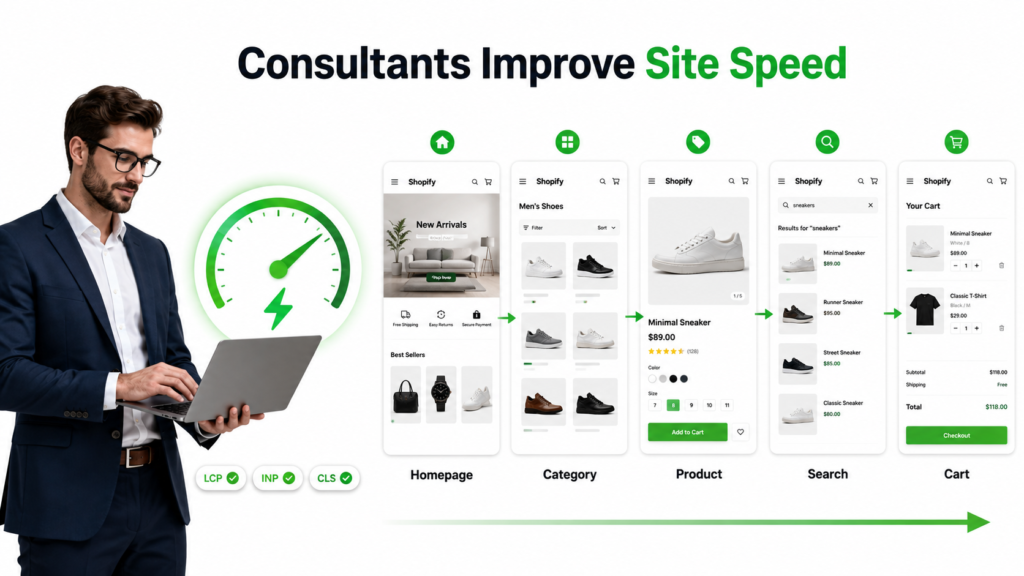
The priority is improving important templates such as:
- Homepage
- Category pages
- Product pages
- Search pages
- Cart-related experiences
Core Web Vitals currently measure loading performance, responsiveness, and visual stability through LCP, INP, and CLS.
A detailed Core Web Vitals ecommerce review can help identify which templates and elements create the largest performance problems.
Better performance supports both search experience and conversion efficiency.
Ecommerce Content Should Support Products, Not Compete With Them
Publishing blog posts without a clear commercial role can increase traffic without increasing sales.
An ecommerce SEO consultant builds supporting content around real customer decisions.
Useful content can answer questions such as:
- Which product type should I choose?
- What size do I need?
- Which material is better?
- What products work together?
- Which model fits a specific use?
- What is the difference between two options?
- How should the product be maintained?
These topics create natural paths into categories and products.
The content becomes part of the ecommerce architecture rather than an isolated blog.
How Consultants Optimize for AI Search and Query Fan-Out
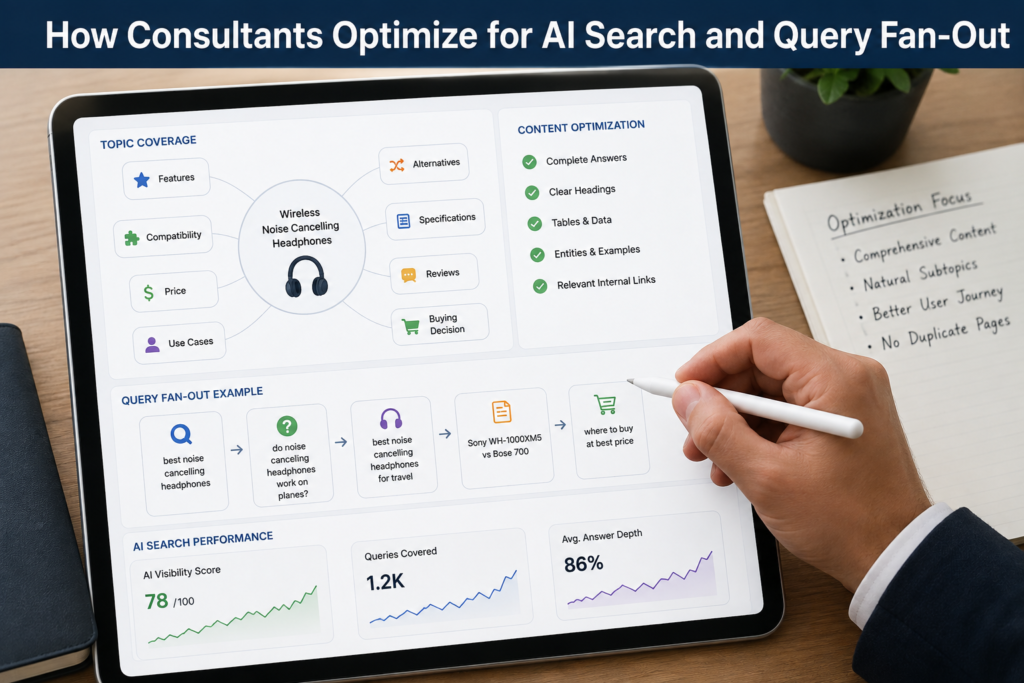
AI search does not remove the need for traditional ecommerce SEO.
Google states that the same core SEO practices remain relevant for AI Overviews and AI Mode, with no special AI schema required for inclusion.
The important change is how completely a page answers a topic.
A broad query can lead search systems toward related questions about features, compatibility, price, use cases, alternatives, specifications, and buying decisions.
A consultant should cover those useful subtopics naturally.
That does not mean creating hundreds of near-identical pages for every possible fan-out query. Google specifically advises against producing separate variations primarily to manipulate rankings or generative AI results.
The better approach is information-dense content with clear headings, direct answers, tables, entities, examples, and relevant internal links.
This also prepares content for query drift, where a shopper begins with one question and gradually moves toward a more specific buying decision.
Three Ecommerce SEO Opportunities That Are Easy to Miss
Technical ecommerce SEO often becomes more valuable when consultants look beyond standard title-tag and content checks.
1. Inventory URL Lifecycle
Products regularly become unavailable, discontinued, replaced, seasonal, or temporarily out of stock.
Automatically deleting these pages can waste rankings, links, and historical demand.
A consultant determines when a URL should remain live, redirect to a replacement, return a 404, or continue serving useful alternatives.
2. Crawl Priority Versus Revenue Priority
A store may have 100,000 crawlable URLs but only a small percentage produce meaningful organic demand.
Consultants identify which categories, subcategories, products, and guides deserve stronger internal links and cleaner crawl paths.
The objective is not “crawl everything.”
It is making commercially important content easy to discover.
3. Template-Level SEO Problems
One template error can affect thousands of pages.
Examples include incorrect canonicals, missing headings, duplicated metadata, broken structured data, or JavaScript that hides important product information.
This is why tools such as Screaming Frog, Search Console, analytics platforms, and log data can be more useful together than separately.
A comparison of the best ecommerce SEO tools can help teams choose the right data source for each problem.
How Ecommerce SEO Consultants Prioritize Work
A long SEO audit is not useful if a store does not know what to fix first.
Experienced consultants prioritize issues using impact, scale, commercial importance, and implementation effort.
| Finding | Typical priority | Why |
| Revenue categories accidentally noindexed | Critical | Commercial pages cannot rank |
| Thousands of filter URLs being crawled | High | Crawl resources are wasted |
| Important categories several clicks deep | High | Discovery and authority are weaker |
| Product schema errors across a template | High | Thousands of products may be affected |
| Slow hero image on key categories | Medium/High | Search and shoppers are affected |
| Missing metadata on discontinued products | Low | Limited commercial value |
This approach prevents development teams from spending weeks fixing minor warnings while larger revenue blockers remain unresolved.
For indexing problems discovered in Search Console, a focused Google Search Console error fixing process can separate real visibility issues from low-impact reports.
How SEO Consultants Measure Whether Sales Are Improving
Rankings are useful indicators, but they are not the final ecommerce KPI.
A consultant should connect SEO work to measurable commercial outcomes.
Important metrics include:
- Organic revenue
- Organic transactions
- Ecommerce conversion rate
- Revenue by landing page
- Non-brand organic clicks
- Category visibility
- Product visibility
- Indexed priority pages
- Crawl efficiency
- Organic assisted conversions
- Revenue from new organic users
The consultant should also segment performance.
A 20% traffic increase means little if the growth came from informational pages while important categories lost customers.
Reporting should show which landing pages gained visibility and whether those gains produced commercial value.
When Should an Ecommerce Business Hire an SEO Consultant?
A consultant becomes especially useful when the store has moved beyond basic SEO fixes.
Common signs include:
- Important categories are not ranking.
- Google indexes unwanted filter URLs.
- Product pages disappear from search.
- Organic traffic grows but sales do not.
- Developers need technical SEO direction.
- A redesign or migration is planned.
- The catalog has grown significantly.
- Search Console reports keep expanding.
- Rankings dropped after technical changes.
Platform knowledge can also matter.
For example, stores dealing with Shopify-specific templates, collection behavior, apps, canonical rules, and JavaScript may benefit from a Shopify technical SEO expert who understands the platform’s limitations.
Do Ecommerce SEO Consultants Guarantee More Sales?
No responsible SEO consultant can guarantee specific rankings or revenue.
SEO depends on competition, demand, product quality, pricing, technical implementation, brand authority, inventory, conversion experience, and many other factors.
What a consultant can do is systematically remove search barriers and improve the probability that qualified shoppers find the right products.
That creates a stronger foundation for sustainable organic revenue.
Run a Screaming Frog Technical SEO Audit Before Scaling Content or Backlinks
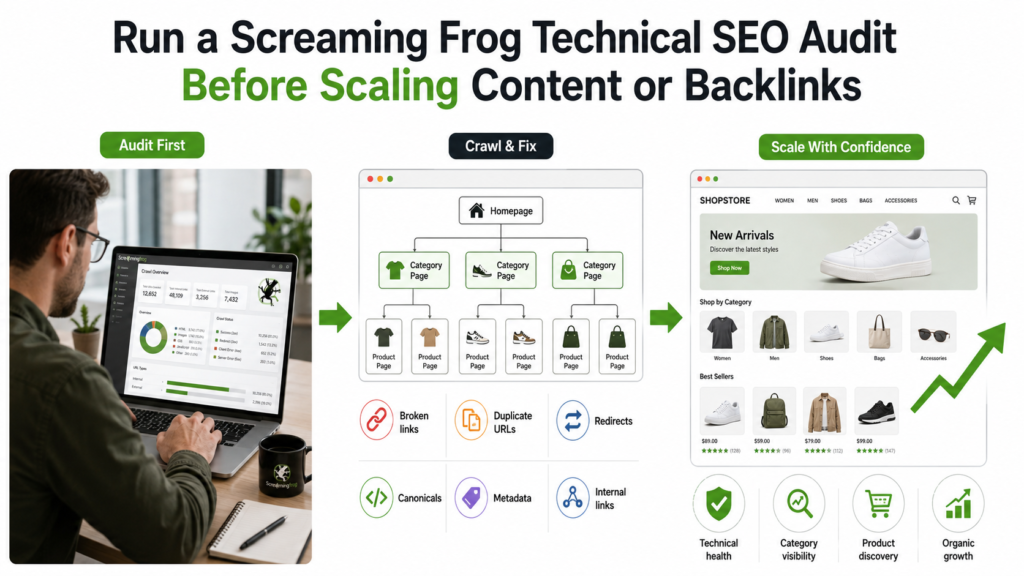
Before increasing content production or link building, crawl the store and understand what search engines currently encounter.
A Screaming Frog ecommerce audit can reveal broken crawl paths, duplicate URLs, incorrect canonicals, redirect problems, indexation signals, weak internal links, missing metadata, and problems hidden across large product catalogs.
E-commerce Technical SEO helps store owners, marketers, developers, and agencies turn this crawl data into practical priorities focused on product discovery, category visibility, technical health, and organic growth.
Our technical SEO specialists focus on ecommerce-specific problems rather than generic SEO checklists. The aim is simple: fix the technical foundation first, then scale content, authority, and site expansion from a cleaner and more measurable base.