

Hiring an ecommerce SEO consultant makes sense when your store has products, degrowth is limited by technical problems, weak category visibility, poor site structure, or unclear SEO priorities.
A strong consultant does more than research keywords. They connect technical SEO, category architecture, product optimization, internal linking, structured data, content, and site performance to outcomes such as product discovery, qualified traffic, conversions, and organic revenue.
The right consultant should also work effectively with developers, marketers, merchandisers, and content teams. Ecommerce SEO improves when your crawl paths, indexable pages, templates, content, and internal signals support the same commercial priorities.
What Does an Ecommerce SEO Consultant Do?
An ecommerce SEO consultant finds the issues limiting category and product visibility, then turns those findings into a prioritized SEO roadmap.
The work should start with evidence. This normally includes crawl data, Google Search Console, analytics, templates, index coverage, internal links, structured data, page performance, and platform limitations.
A consultant may handle:
- Technical SEO audits and implementation planning
- Category and subcategory optimization
- Product page SEO and variant handling
- Faceted navigation and URL parameter control
- Internal linking and crawl-depth improvements
- Canonical, robots, and indexation decisions
- Product and merchant structured data
- Core Web Vitals and template performance
- Commercial content strategy
- Migration and redesign SEO
- Post-deployment SEO validation
For larger stores, the consultant must understand the difference between crawlability and indexation.
A URL being discoverable does not automatically mean it should be indexed or expected to rank.
When Should You Hire an Ecommerce SEO Consultant?

The best time to hire a consultant is before technical debt becomes expensive.
You may need specialist help when Google spends resources crawling low-value filters while important categories remain weak, or when inventory changes create broken links, duplicate pages, and unstable index coverage.
| Store situation | What the consultant investigates | Business impact |
| Organic growth is flat | Technical barriers, search intent, category quality | More qualified visibility |
| Thousands of parameter URLs exist | Facets, canonicals, crawl paths | Better crawl efficiency |
| Categories rank poorly | Architecture, internal links, content | More commercial traffic |
| Products disappear from Google | Sitemaps, inventory rules, indexation | Stable product visibility |
| A redesign is planned | Redirects, templates, rendering | Lower migration risk |
| Pages are slow | Images, scripts, templates, third parties | Better UX and conversion support |
A consultant is especially valuable before a platform migration, catalog expansion, international rollout, redesign, or major content campaign.
Starting with a technical SEO audit helps identify limitations before you commit more budget.
Why Ecommerce SEO Requires Specialist Experience
Ecommerce websites create SEO problems that rarely exist at the same scale on service websites or blogs.
Filters, sorting, pagination, product variants, tracking parameters, internal search, and changing inventory can generate thousands or millions of URLs.
Search engines need clear signals about which URLs matter.
An ecommerce specialist should understand how to control ecommerce URL parameters without accidentally removing valuable long-tail category opportunities.
Technical decisions also affect revenue pages directly.
A bad canonical rule can suppress a category. An incorrect robots.txt rule can restrict crawling. Poor architecture can leave profitable collections buried several clicks from the homepage.
What Skills Should an Ecommerce SEO Consultant Have?
Do not evaluate consultants only by ranking screenshots or the number of SEO tools they use.
Look for their ability to diagnose the system behind a problem, prioritize it, explain the commercial impact, and give developers clear implementation guidance.
| Skill area | Strong capability | Useful evidence |
| Crawling and indexation | Separates crawling, canonicalization, and indexing | Crawl and GSC comparison |
| Site architecture | Builds logical paths to priority pages | Crawl depth and inlink analysis |
| Faceted navigation | Controls crawl space while preserving useful filters | Parameter strategy |
| Structured data | Validates Product, Offer, Review, Breadcrumb entities | Structured data extraction |
| Performance | Finds shared template problems | Core Web Vitals analysis |
| Ecommerce content | Connects guides with commercial pages | Intent and page mapping |
| Analytics | Measures traffic and revenue outcomes | GSC, GA4, store data |
| Implementation QA | Tests changes after deployment | Before-and-after crawls |
A capable consultant should be comfortable with Screaming Frog, Google Search Console, GA4, PageSpeed Insights, and ecommerce platform data.
The tools support the analysis. They do not replace technical judgment.
For a wider tool stack, review these ecommerce SEO tools.
Three Technical Capabilities That Separate Specialists From Generalists
1. Crawl-Space Management
Crawl budget is often discussed too broadly.
For ecommerce stores, the more practical issue is crawl space: how many useful and low-value URL combinations the website exposes to crawlers.
A specialist should identify:
- Filter combinations
- Sorting parameters
- Tracking URLs
- Pagination
- Internal search pages
- Duplicate variants
- Session parameters
- Empty filtered categories
The objective is not simply to reduce URLs. It is to help search engines spend more crawling activity on pages capable of generating visibility and revenue.
A strong consultant also understands when robots.txt for ecommerce is appropriate and when canonicals, noindex directives, internal linking, or platform changes are better controls.
2. Server-Log and Crawl Validation
SEO crawlers show what can be reached. Server logs can help show what search-engine bots actually request.
For large stores, combining both datasets can reveal whether crawlers repeatedly visit parameter traps while important products or categories receive limited attention.
Log analysis becomes particularly useful for stores with:
- Very large catalogs
- Millions of crawlable URLs
- Headless architecture
- Frequent inventory changes
- Complex faceted navigation
- Unexplained product discovery problems
This gives the consultant evidence for crawl-control decisions instead of relying only on assumptions.
3. Inventory Lifecycle SEO
Products become unavailable, return to stock, change variants, or disappear permanently.
Each situation may require a different SEO action.
A consultant should decide whether to retain the URL, show alternatives, return a real 404 or 410, redirect to a close replacement, or update internal links and XML sitemaps.
This prevents random redirect rules from damaging relevance and user experience.
Ecommerce SEO Consultant vs Agency vs In-House SEO
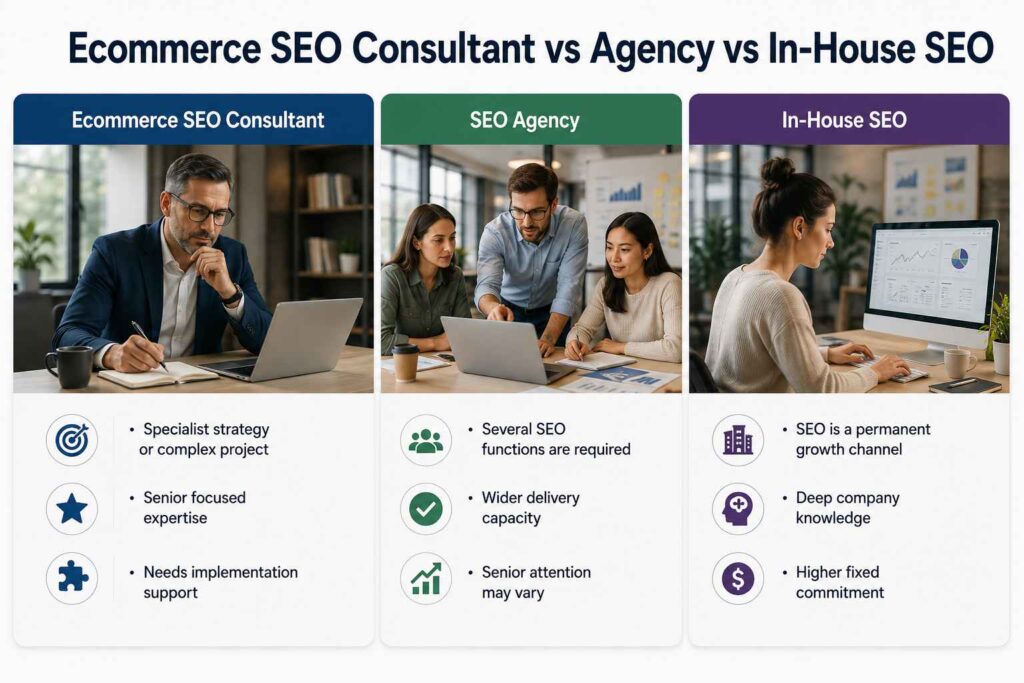
The right model depends on your website size, internal resources, development capacity, and required specialist depth.
| Option | Best fit | Main advantage | Main limitation |
| Ecommerce SEO consultant | Specialist strategy or complex project | Senior focused expertise | Needs implementation support |
| SEO agency | Several SEO functions are required | Wider delivery capacity | Senior attention may vary |
| In-house SEO | SEO is a permanent growth channel | Deep company knowledge | Higher fixed commitment |
| General SEO freelancer | Smaller, simpler websites | Lower entry cost | Limited ecommerce depth |
An ecommerce consultant can also support an existing agency or internal team.
They may audit architecture, review technical specifications, challenge priorities, help developers plan changes, or validate high-risk releases.
How Much Does an Ecommerce SEO Consultant Cost?
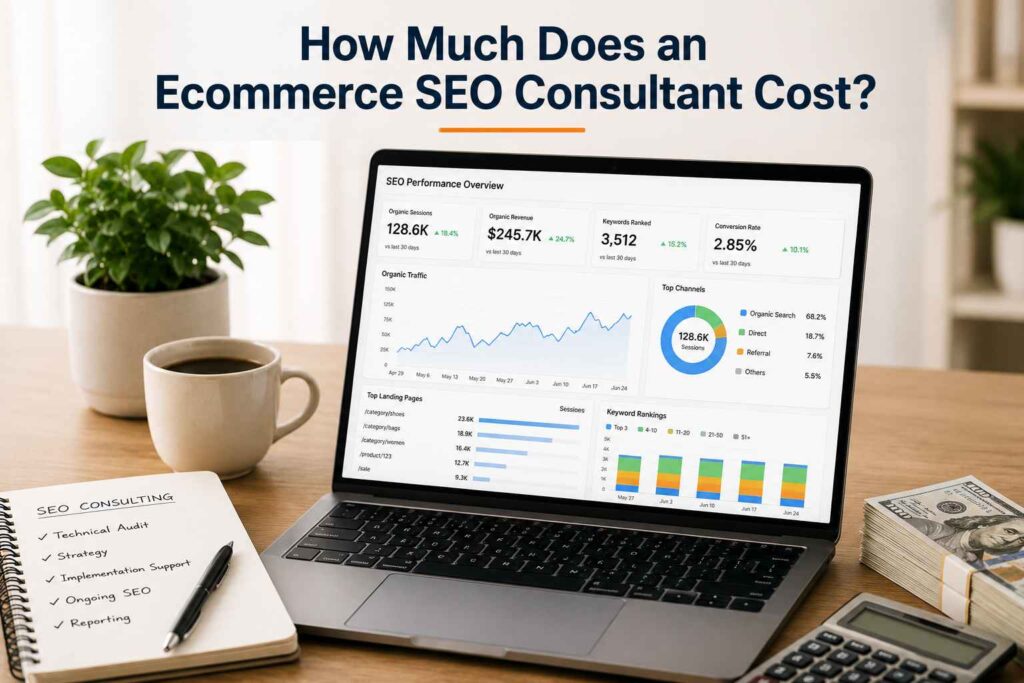
There is no useful single price for ecommerce SEO consulting.
Cost depends on catalog size, platform complexity, international setup, technical debt, development requirements, and whether you need an audit, implementation support, or ongoing strategy.
Common engagement models include:
- One-time technical audit
- Fixed-scope consulting project
- Monthly SEO consulting retainer
- Hourly or day-rate advisory work
- Migration or redesign support
- Ongoing technical SEO oversight
Compare consultants by scope and expected business value rather than choosing only by the lowest monthly fee.
How to Evaluate an Ecommerce SEO Consultant Before Hiring
Ask questions that reveal how the consultant thinks.
Avoid asking, “Can you rank us number one?”
No responsible SEO consultant can guarantee a specific ranking.
Instead, ask:
- How would you decide which faceted URLs should be indexable?
- How do you compare crawl data with Google Search Console?
- What would you check before changing robots.txt?
- How do you handle discontinued products?
- How do you prioritize development tickets?
- What do you measure besides keyword rankings?
- How do you validate whether a technical fix worked?
- Which ecommerce platforms have you worked with directly?
Good answers should include trade-offs.
Ecommerce SEO often requires balancing crawler access, indexation, shopper navigation, merchandising needs, search demand, and platform limitations.
Reviewing an ecommerce technical SEO audit framework can also help you understand the depth a specialist should provide.
What Should the First 90 Days Look Like?
A consultant should not spend three months producing reports without creating clear decisions.
The first phase should establish a baseline, identify high-impact problems, coordinate fixes, and create a repeatable measurement process.
| Period | Main focus | Typical output |
| Days 1–30 | Diagnose and prioritize | Crawl baseline, index review, backlog, KPI baseline |
| Days 31–60 | Implement major fixes | Architecture, canonicals, links, schema, tickets |
| Days 61–90 | Validate and expand | Recrawl, GSC review, content priorities, roadmap |
The exact sequence depends on the store.
A smaller Shopify store may move quickly. An enterprise catalog may require engineering reviews, staging environments, release windows, template testing, and deeper URL segmentation.
For Shopify stores, platform experience matters. A Shopify technical SEO expert should understand collections, canonical behavior, variants, apps, themes, and JavaScript performance.
How Should Ecommerce SEO Work Be Prioritized?
The biggest technical issue is not always the first issue worth fixing.
A useful prioritization framework considers four factors:
- Impact: Can the change improve important product or category visibility?
- Scale: How many URLs or templates are affected?
- Confidence: Is there evidence that the issue limits performance?
- Effort: How much development or content work is required?
Fixing one title tag is easy but affects one page.
Correcting a category template that generates conflicting canonical signals across thousands of URLs may produce much greater value.
Internal linking can also create scalable improvements.
Strong internal linking for ecommerce category pages helps search engines find priority categories and understand their relationships with products, subcategories, and supporting content.
Should an Ecommerce SEO Consultant Understand AI Search?
Yes, but this should not replace SEO fundamentals.
AI search visibility still depends heavily on clear, useful, crawlable, indexable, trustworthy content and strong page relationships.
A consultant should focus on making information easy to extract and understand through:
- Clear question-led headings
- Direct answers
- Strong entity relationships
- Descriptive product information
- Logical internal linking
- Accurate structured data
- Useful comparisons and tables
- Unique first-hand or business-specific information
Avoid consultants selling “AEO” or “GEO” as a shortcut around weak technical SEO.
A store that cannot consistently expose, index, and explain its important products will have a weak foundation across both traditional and AI-assisted search experiences.
What Results Should You Expect?
Expect better SEO decisions before expecting instant ranking changes.
Early improvements may include cleaner crawl patterns, fewer indexation conflicts, stronger category discovery, better internal links, valid structured data, faster templates, and a clearer development backlog.
Search performance should then be measured by business value.
Useful KPIs can include:
- Non-brand organic clicks
- Category page traffic
- Organic product sessions
- Indexed commercial pages
- Search CTR
- Organic conversions
- Organic revenue
- Revenue by landing-page type
Where Search Console shows confusing indexing or validation problems, specialist Google Search Console error fixing can help identify what needs action and what simply needs correct interpretation.
Red Flags When Hiring an Ecommerce SEO Consultant
Avoid consultants who use generic audit checklists without understanding your catalog, templates, platform, and commercial priorities.
Warning signs include:
- Guaranteed rankings
- Fixed traffic promises
- Blocking parameters without analysis
- Applying noindex rules across large URL groups without reviewing demand
- Redirecting every discontinued product to the homepage
- Treating every crawler warning as equally important
- Reporting rankings without conversion or revenue context
- Making recommendations without implementation guidance
- Ignoring developers and merchandising teams
- Never validating fixes after deployment
A capable consultant should explain what needs changing, why it matters, how it should be implemented, and how success will be checked.
Hire an Ecommerce SEO Consultant Who Can Work Across Teams
Ecommerce SEO sits between marketing, merchandising, content, and engineering.
A consultant may find the problem, but developers may need to change templates, navigation, rendering, or structured data. Merchandising teams may control categories and availability. Content teams may manage guides and collection copy.
That makes communication part of technical SEO.
Our technical SEO specialists turn crawl, indexation, architecture, structured data, and performance findings into practical actions for store owners, marketing teams, developers, and agencies.
The objective is not to produce the longest audit.
It is to make commercially important pages easier to discover, understand, index, rank, and improve.
Run a Screaming Frog Audit Before Scaling Content or Backlinks
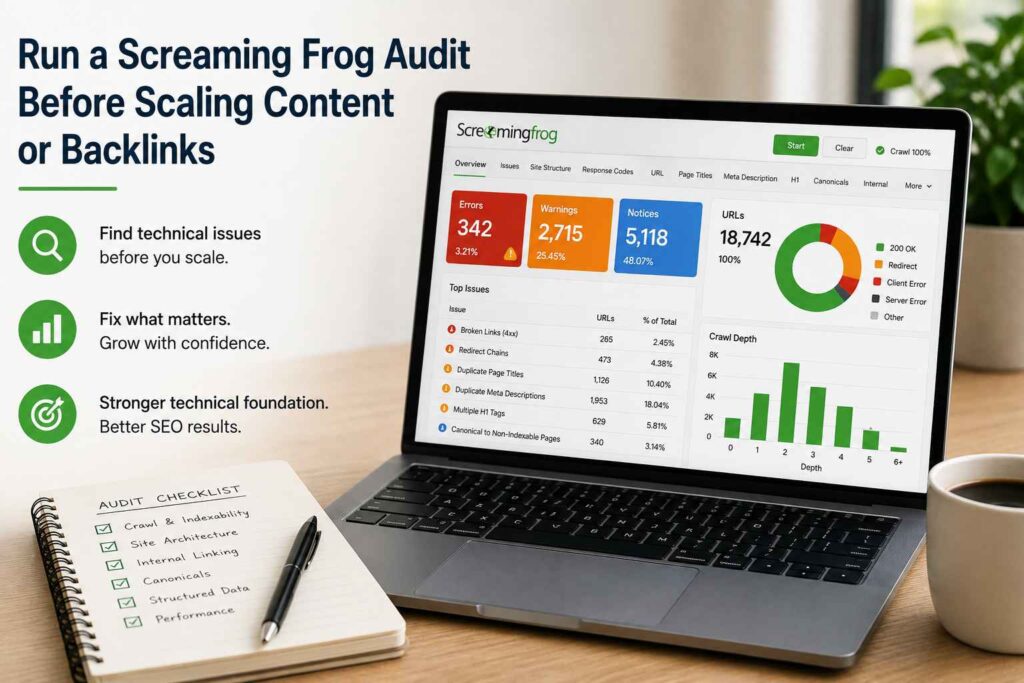
Before increasing content production or link building, establish a technical baseline with Screaming Frog.
A controlled ecommerce crawl can expose broken links, redirect chains, parameter patterns, crawl traps, canonical conflicts, indexability problems, weak internal linking, duplicate metadata, structured data errors, and important pages buried too deeply.
Our guide to a Screaming Frog ecommerce SEO audit shows how to turn crawl data into practical priorities instead of treating every crawler warning as an equally serious SEO problem.
E-commerce Technical SEO helps store owners, marketers, developers, and agencies identify the technical issues that hold back organic growth.
The goal is simple: make important category and product pages easier for search engines to reach, understand, index, and rank before you commit more budget to content, backlinks, or site expansion.
A stronger technical foundation gives every later SEO investment a better chance to perform.