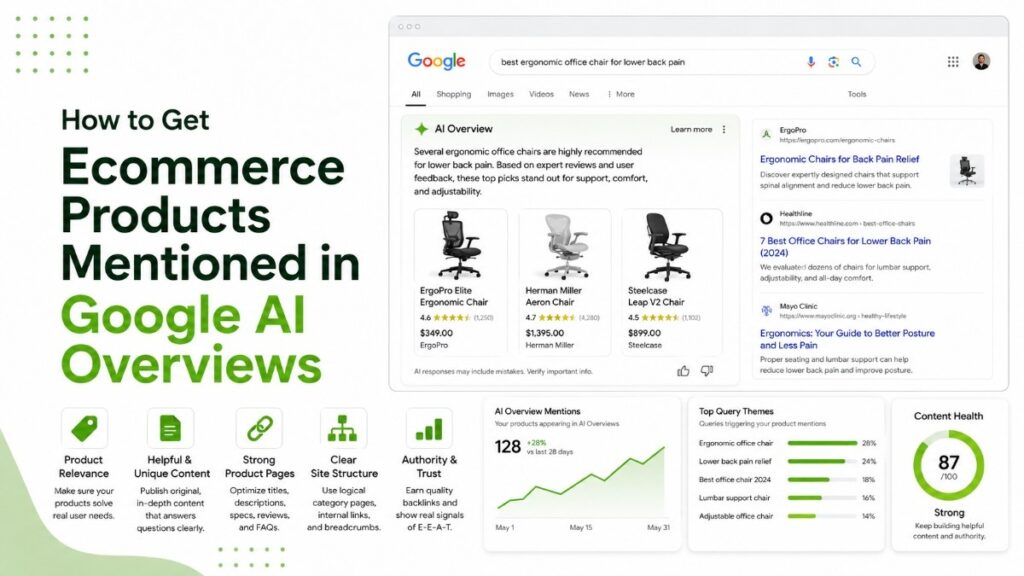



Google AI Overview list products. A mention may appear as a recommendation, cited source, comparison option, or shopping result connected to an AI-generated answer.
There is no guaranteed method or special “AI Overview schema.” Google says eligible pages must be indexed, allowed to show a Search snippet, and built around established SEO practices. Your advantage comes from making product information easy to crawl, understand, verify, and reuse. a Product Eligible for AI Overview Visibility?
Google may use query fan-out for AI Overviews and AI Mode. One complex search can trigger several related searches across subtopics and data sources before Google builds its response. oof hiking shoes for wide feet” may expand into fit, materials, grip, terrain, weight, reviews, price, returns, and availability.
Your product becomes more useful evidence when:
- The page is crawlable and indexed.
- The product is clearly identified.
- Features connect to shopper benefits.
- Price and stock are current.
- Schema matches visible content.
- Merchant Center matches the website.
- Supporting guides answer buying questions.
- Reviews support important claims.
Start with reliable product crawl access. A blocked product page cannot become a supporting Search link.
Build Topical Authority Around Shopping Decisions
AI Overview optimization is broader than ranking one page for one keyword. You need useful coverage across the questions shoppers ask before, during, and after comparison.
A 2025 study reported that pages ranking across fan-out queries were 161% more likely to receive AI Overview citations than pages ranking only for the primary query. This was correlation, not a guarantee, but it supports a topic-first strategy. duct cluster may include:
- A category buying guide
- Product comparison pages
- Material or technology explainers
- Size, fit, or compatibility guides
- Care and troubleshooting content
- Shipping and returns information
- Individual product pages
Avoid unrelated content added only to increase article count. Every page should support a real decision, use case, objection, technical question, or ownership concern.
Use a technical audit process to confirm these pages are discoverable, internally linked, and free from indexing conflicts.
Map Fan-Out Queries and Query Drift
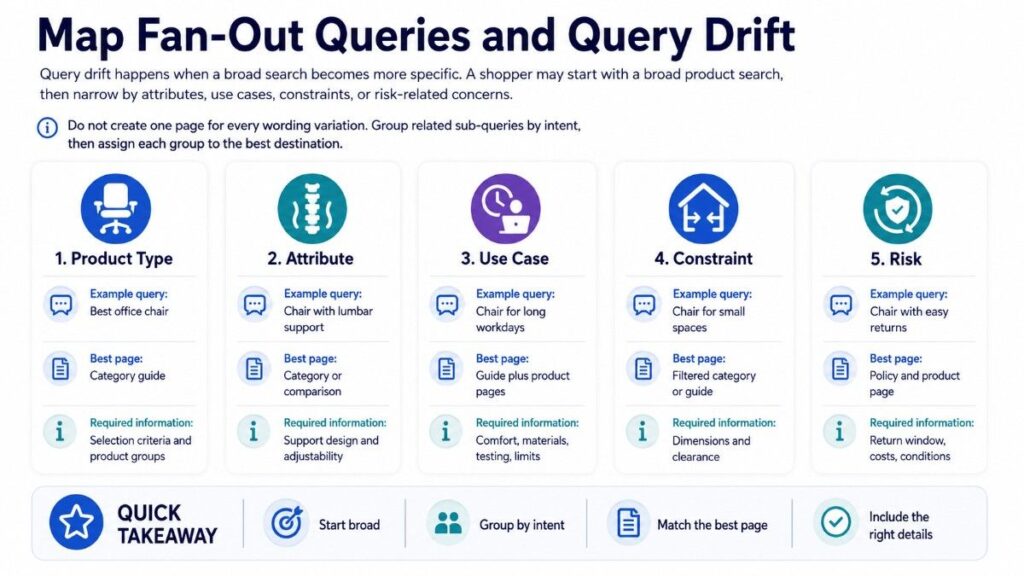
Query drift happens when a broad search becomes more specific. A shopper may start with “best office chair,” then focus on back support, height range, small spaces, assembly, or warranty.
Do not create one page for every wording variation. Group related sub-queries by intent, then assign each group to the best destination.
| Query layer | Example query | Best page | Required information |
|---|---|---|---|
| Product type | Best office chair | Category guide | Selection criteria and product groups |
| Attribute | Chair with lumbar support | Category or comparison | Support design and adjustability |
| Use case | Chair for long workdays | Guide plus product pages | Comfort, materials, testing, limits |
| Constraint | Chair for small spaces | Filtered category or guide | Dimensions and clearance |
| Risk | Chair with easy returns | Policy and product page | Return window, costs, conditions |
Build your map from Search suggestions, People Also Ask, customer questions, site search, reviews, product filters, Merchant Center insights, and competitor category structures.
Record four fields: shopper question, intent, destination page, and required proof.
A storewide SEO audit can reveal whether category, filter, guide, and product pages cover these journeys or compete with each other.
Make Product Information Clear and Consistent
Google needs to confirm that the product shown on your page is the same product listed in structured data and Merchant Center.
Keep the product name, brand, GTIN or MPN, variant, price, and availability consistent across every source. Conflicting details can make the product harder to understand, match, and display in AI-powered shopping results.
| Product detail | Where it should match | Common problem | Recommended fix |
|---|---|---|---|
| Product name and brand | Page, schema, and feed | Different naming formats | Use one naming standard |
| GTIN, MPN, and SKU | Schema and product feed | Missing or incorrect identifiers | Verify manufacturer data |
| Size and color variants | URL, selector, schema, and feed | Variant details do not match | Align each product variant |
| Price and availability | Page, Offer schema, and feed | Outdated price or stock status | Synchronize updates |
| Shipping and returns | Product page, policies, and feed | Conflicting information | Show consistent terms |
Google supports ProductGroup structured data for products available in different sizes, colors, materials, or patterns. The structured data should always match the information shoppers can see on the page.
Use an audit checklist to identify product-data inconsistencies across large ecommerce templates.
Write Product Pages AI Systems Can Understand
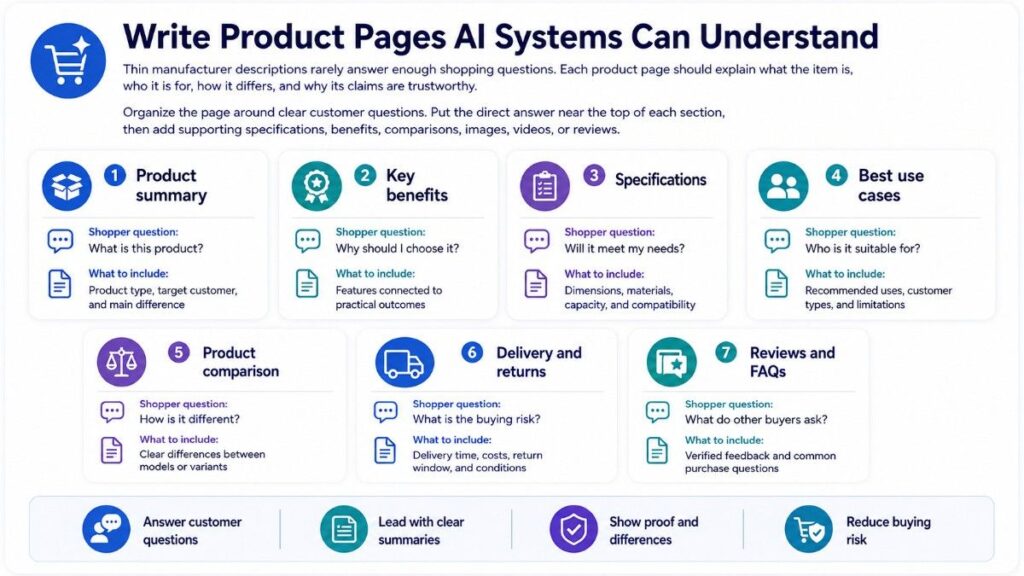
Thin manufacturer descriptions rarely answer enough shopping questions. Each product page should explain what the item is, who it is for, how it differs, and why its claims are trustworthy.
Organize the page around clear customer questions. Put the direct answer near the top of each section, then add supporting specifications, benefits, comparisons, images, videos, or reviews.
| Product page section | Shopper question | What to include |
|---|---|---|
| Product summary | What is this product? | Product type, target customer, and main difference |
| Key benefits | Why should I choose it? | Features connected to practical outcomes |
| Specifications | Will it meet my needs? | Dimensions, materials, capacity, and compatibility |
| Best use cases | Who is it suitable for? | Recommended uses, customer types, and limitations |
| Product comparison | How is it different? | Clear differences between models or variants |
| Delivery and returns | What is the buying risk? | Delivery time, costs, return window, and conditions |
| Reviews and FAQs | What do other buyers ask? | Verified feedback and common purchase questions |
Keep important product details in visible text rather than placing them only inside images, videos, tabs, or downloadable files. Supporting media can improve understanding, but it should not replace the information Google and shoppers need to read.
Use Merchant Center as a Product Data Source
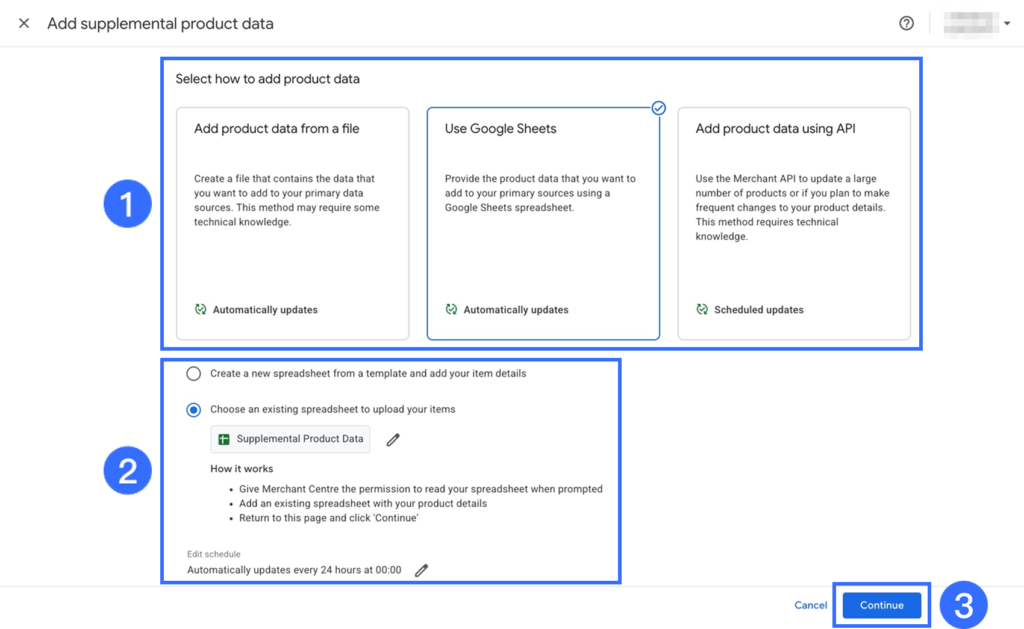
Google Merchant Center can provide product information for Search, Images, Lens, Shopping, Gemini, and other Google surfaces. Accurate data improves eligibility, but inclusion is never guaranteed. – Titles and descriptions
- High-quality images
- GTIN, MPN, and brand
- Price and availability
- Condition
- Shipping and returns
- Product category and type
- Variant grouping
Keep the feed, visible page, and structured data synchronized. Conflicting prices, stock states, identifiers, or variant names can reduce trust and create Merchant Center issues.
Add Product Structured Data Correctly
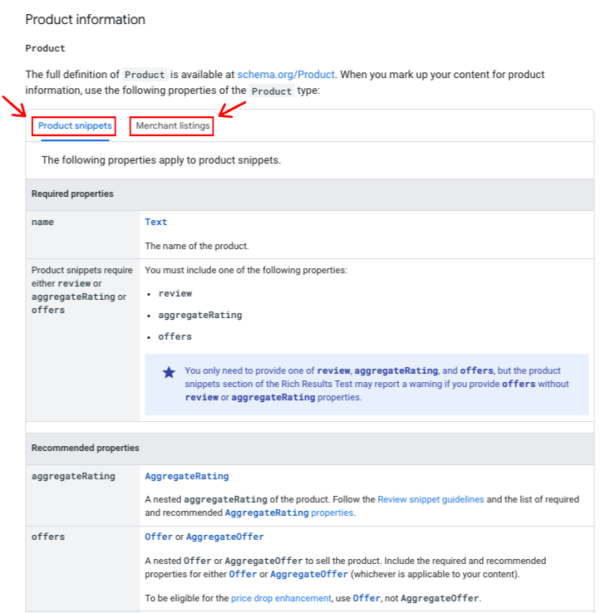
Use Product and Offer markup on pages where shoppers can buy a specific product. Merchant listing markup can communicate price, availability, shipping, returns, ratings, and identifiers. rkup in the initial HTML when possible.
Google warns that JavaScript-generated product markup can make shopping crawls less reliable for fast-changing details. lates with the Rich Results Test, inspect live URLs, and monitor Merchant Listings and Product Snippets reports.
Review store speed metrics as well. Faster, stable templates support user experience and conversion performance.
Strengthen Trust Beyond Your Product Pages
AI-generated shopping answers may use several sources. Your site supplies first-party facts, while independent sources can provide validation.
Useful trust signals include customer reviews, original testing, clear authorship, manufacturer documentation, consistent marketplace listings, editorial coverage, and transparent warranty or returns information.
Do not manufacture forum mentions, reviews, or expert quotes. Manipulative promotion creates reputation risk and weakens trust.
Measure AI Visibility Alongside Rankings
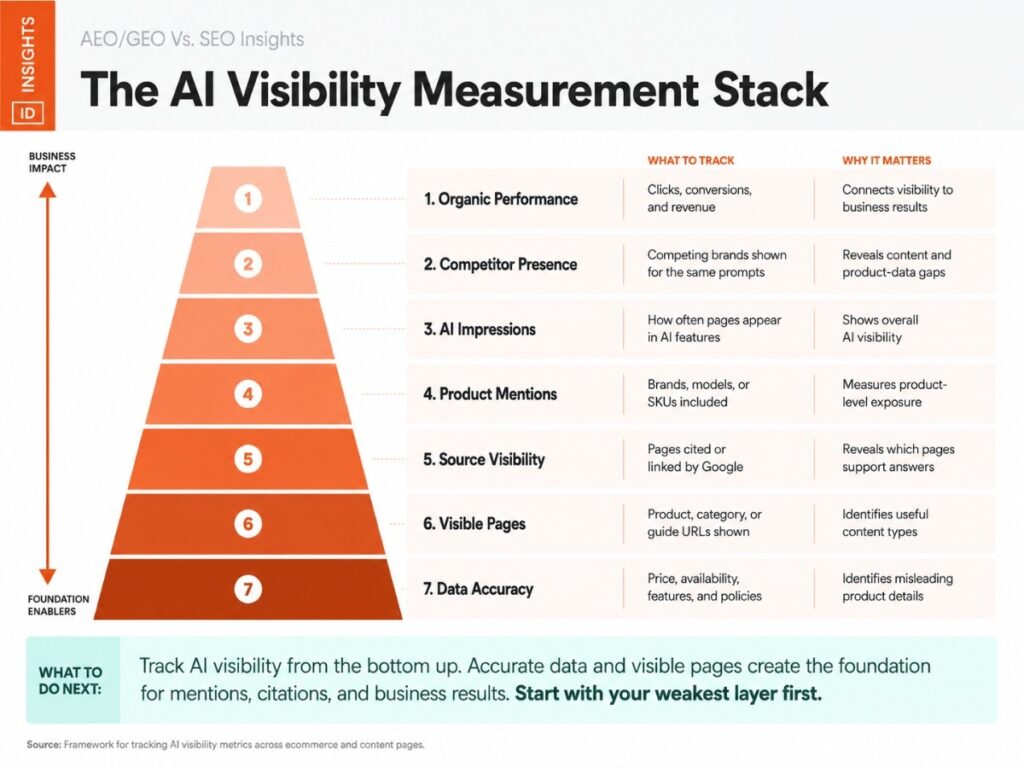
Google Search Console has introduced dedicated Generative AI performance reports for selected websites. These reports show which pages appeared in AI Overviews and AI Mode, along with impressions, countries, devices, and visibility trends. The reports are still being rolled out and may not be available for every website.
Merchant Center also provides AI performance insights for eligible accounts. These insights help merchants understand how their brands appear in AI Mode and AI Overviews across different stages of the shopping journey.
Use these reports with standard SEO, revenue, and product-performance data. AI visibility alone does not show whether a mention produced qualified traffic or sales.
| Measurement | What to track | Why it matters |
|---|---|---|
| AI impressions | How often pages appear in AI features | Shows overall AI visibility |
| Visible pages | Product, category, or guide URLs shown | Identifies useful content types |
| Product mentions | Brands, models, or SKUs included | Measures product-level exposure |
| Source visibility | Pages cited or linked by Google | Reveals which pages support answers |
| Data accuracy | Price, availability, features, and policies | Identifies misleading product details |
| Organic performance | Clicks, conversions, and revenue | Connects visibility to business results |
| Competitor presence | Competing brands shown for the same prompts | Reveals content and product-data gaps |
Test a consistent set of shopping prompts each month. Include category, comparison, attribute, use-case, problem-solving, and branded searches.
Record the prompt, date, location, device, products shown, cited pages, and accuracy of the answer. AI results can change between searches, so measure patterns over time instead of relying on one result.
Three High-Value Entities Many Stores Miss
Product Identity Relationships
Connect the parent product, variants, identifiers, brand, offers, reviews, and category. This reduces ambiguity across similar URLs and models.
Purchase-Risk Information
Shipping time, return costs, warranty coverage, assembly needs, and compatibility limits often influence buying decisions. Make these facts easy to compare.
Evidence Behind Benefits
Support benefits with test conditions, dimensions, materials, certifications, review patterns, or a clear method. Evidence gives Google stronger facts for grounding an answer.
A Practical 30-Day Plan
Week 1: Establish Eligibility
Check robots.txt, canonicals, status codes, index coverage, sitemaps, internal links, rendered content, and template performance.
Week 2: Align Product Data
Match identifiers, variants, prices, stock, shipping, and returns across pages, structured data, and Merchant Center.
Week 3: Improve Coverage
Upgrade priority products, publish one buying guide, add comparison details, and answer recurring customer questions.
Week 4: Validate and Measure
Test markup, inspect URLs, review Merchant Center issues, establish prompt tracking, and compare visibility with competitors.
Run a Technical SEO Audit Before Scaling AI Content or Backlinks
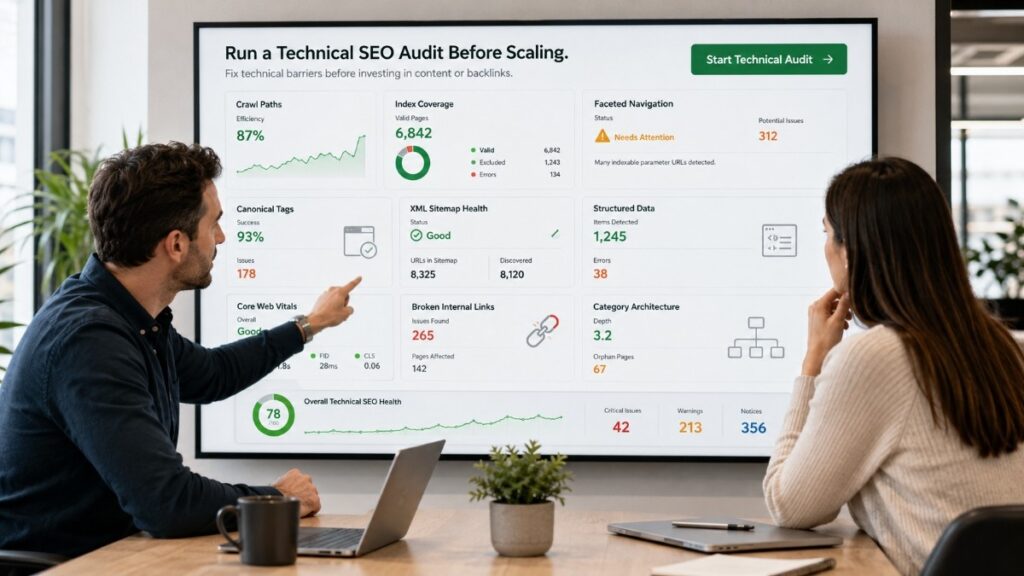
Before investing in more content, digital PR, or backlinks, audit crawl paths, index coverage, faceted navigation, product templates, canonicals, sitemaps, structured data, Merchant Center alignment, and performance.
E-commerce Technical SEO helps store owners, marketers, developers, and agencies find technical issues that limit product discovery, organic traffic, AI visibility, and revenue.
A clear review creates a stronger foundation before expanding topic clusters or product feeds. Our technical SEO specialists focus on making important ecommerce pages easier to find, understand, index, and rank.
Confirm the audit scope and purpose before scaling changes across thousands of products.