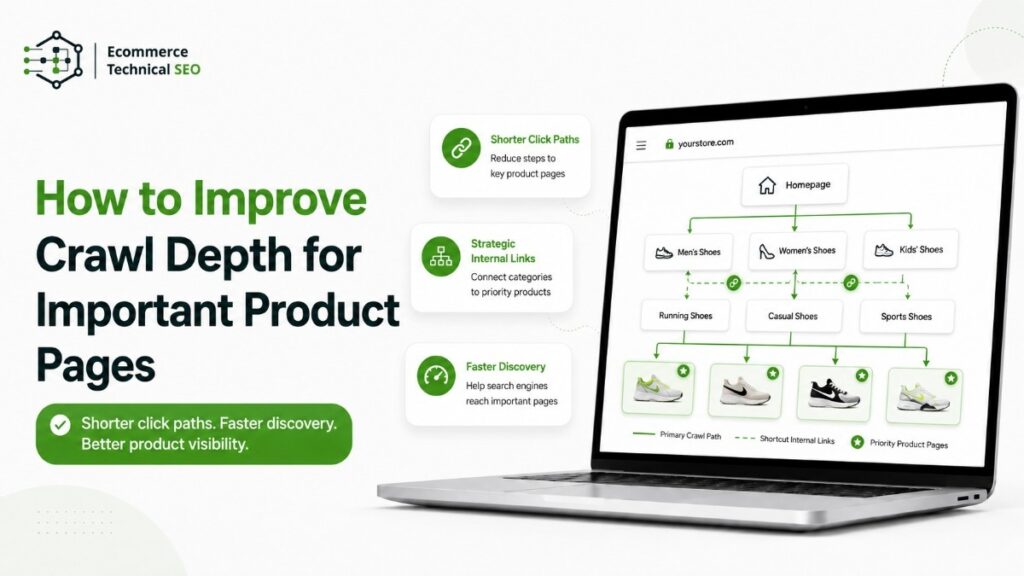



Important ecommerce product pages should not be buried behind long navigation paths.
When a high-value product requires several clicks to reach, search engines may have fewer direct internal paths to discover it. The page may also receive weaker internal link signals than products connected to major categories, navigation elements, and relevant product pages.
Improving crawl depth is not simply about making every URL three clicks from the homepage. The goal is to make commercially important product pages easy to discover through clear, crawlable, relevant internal links.
Google specifically recommends linking to products you want indexed. If category pages do not link to all products, Googlebot may not discover those products through normal crawling alone.
This guide explains how to find deeply buried products, decide which pages deserve priority, and improve their crawl paths without creating an oversized or confusing site architecture.
What Is Crawl Depth in Ecommerce SEO?
Crawl depth measures how many internal link steps separate one page from the starting page of a crawl, usually the homepage.
A simple ecommerce structure may look like this:
Homepage → Category → Subcategory → Product
The product sits three link levels away from the homepage.
A deeper structure might look like:
Homepage → Department → Category → Subcategory → Filter → Pagination → Product
That product can become much harder to reach through normal navigation.
Crawl depth matters because search engines discover pages by following crawlable links. Google also uses links to understand relationships between pages and discover new URLs.
Crawl Depth Is Not the Same as URL Folder Depth
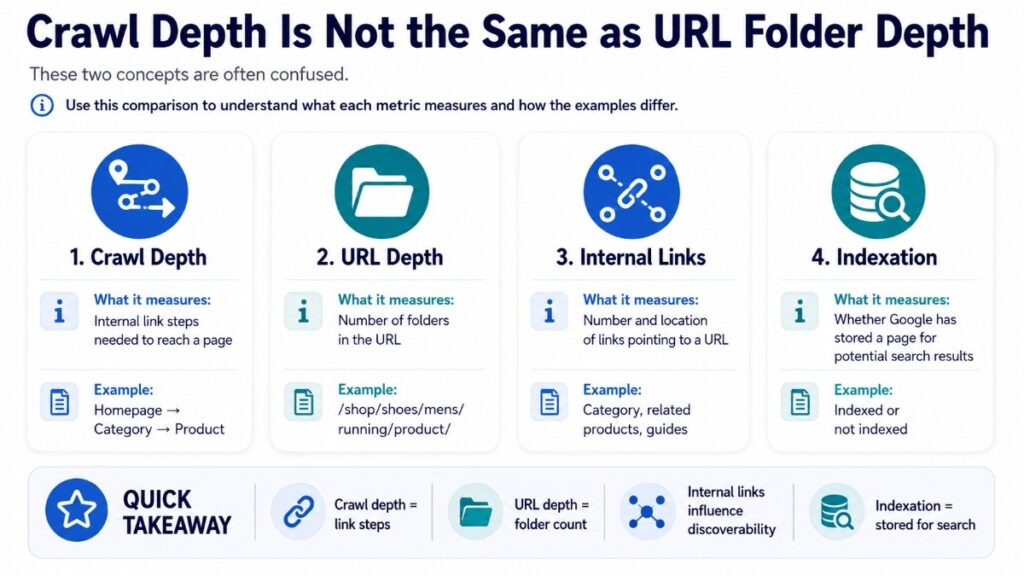
These two concepts are often confused.
| Metric | What It Measures | Example |
|---|---|---|
| Crawl depth | Internal link steps needed to reach a page | Homepage → Category → Product |
| URL depth | Number of folders in the URL | /shop/shoes/mens/running/product/ |
| Internal links | Number and location of links pointing to a URL | Category, related products, guides |
| Indexation | Whether Google has stored a page for potential search results | Indexed or not indexed |
A long URL does not automatically mean a page has poor crawl depth.
Likewise, a short URL such as /product-123/ can still be deeply buried if very few crawlable pages link to it.
Understanding the difference between crawlability and indexation is important before changing your architecture. A product can be crawlable without being indexed, and indexed pages can still have weak internal positioning.
How Deep Should Important Product Pages Be?
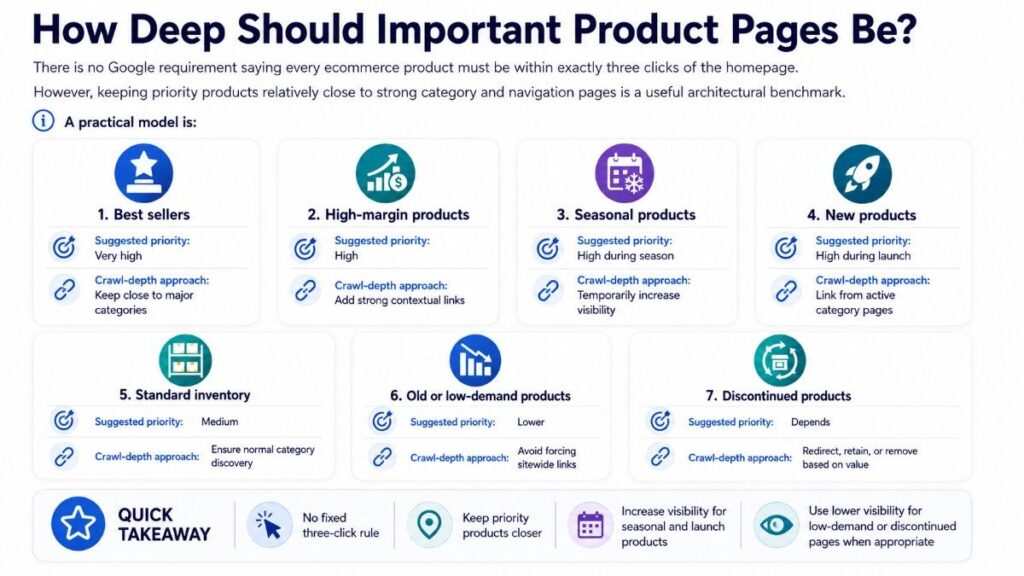
There is no Google requirement saying every ecommerce product must be within exactly three clicks of the homepage.
However, keeping priority products relatively close to strong category and navigation pages is a useful architectural benchmark.
A practical model is:
| Product Type | Suggested Priority | Crawl-Depth Approach |
|---|---|---|
| Best sellers | Very high | Keep close to major categories |
| High-margin products | High | Add strong contextual links |
| Seasonal products | High during season | Temporarily increase visibility |
| New products | High during launch | Link from active category pages |
| Standard inventory | Medium | Ensure normal category discovery |
| Old or low-demand products | Lower | Avoid forcing sitewide links |
| Discontinued products | Depends | Redirect, retain, or remove based on value |
The important principle is priority-based architecture, not artificial flattening.
A store with 200 products can use a much flatter structure than a marketplace containing hundreds of thousands of SKUs.
Start by Identifying Products That Actually Matter
Do not reduce crawl depth for every product simply because a crawler reports a high number.
Start with products that have commercial or organic-search value.
Prioritize URLs using signals such as:
- Organic clicks and impressions
- Revenue
- Conversion rate
- Profit margin
- Search demand
- Product availability
- Backlinks
- Strategic brand importance
- Seasonal demand
- New-product priority
This prevents developers from changing navigation just to improve a technical metric.
The objective of good category internal linking is to help search engines and shoppers move naturally from broader commercial pages toward the products that deserve visibility.
Audit Product Crawl Depth With Screaming Frog
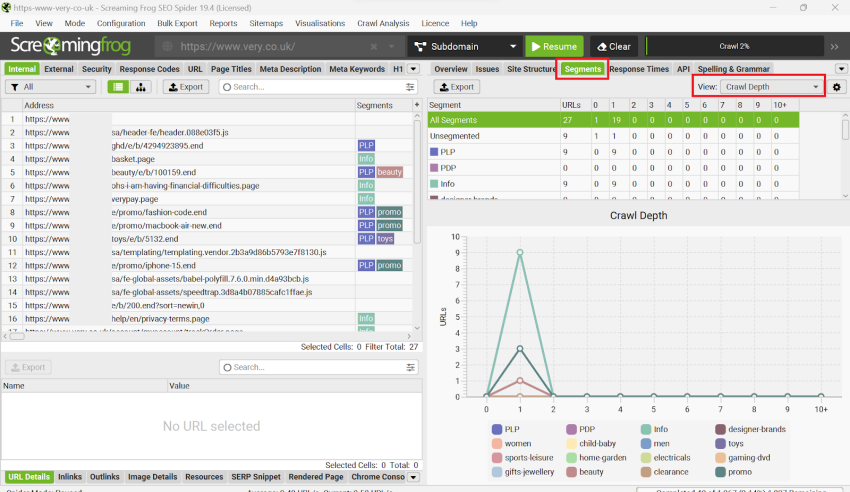
Screaming Frog is especially useful because it can report crawl depth, internal links, anchor text, indexability, redirects, and site architecture in the same crawl.
For ecommerce sites, crawl the site before making architecture changes.
Your Screaming Frog audit workflow should identify both deeply buried product pages and the reason they became deep.
What to Export
After crawling, create a product-level dataset containing:
| Data Point | Why It Matters |
|---|---|
| URL | Identifies the product |
| Crawl depth | Shows structural distance |
| Indexability | Prevents optimizing non-indexable pages |
| Internal inlinks | Shows internal link support |
| Unique inlinks | Identifies how many pages provide links |
| Status code | Finds broken or redirected products |
| Canonical | Checks preferred URL |
| Organic clicks | Adds SEO performance context |
| Revenue | Adds commercial priority |
Do not analyze crawl depth alone.
A product at depth four with hundreds of strong contextual links may be less concerning than a depth-three product linked from only one weak pagination page.
Segment Product URLs Before Comparing Depth
Different templates should be evaluated separately.
Create segments for:
- Products
- Categories
- Subcategories
- Brands
- Filter pages
- Blog content
- Pagination
- Search URLs
Screaming Frog supports analysis of site architecture and crawl depth by page type or segment, which makes ecommerce diagnosis more useful than reviewing one sitewide average.
Improve Category-to-Product Linking First
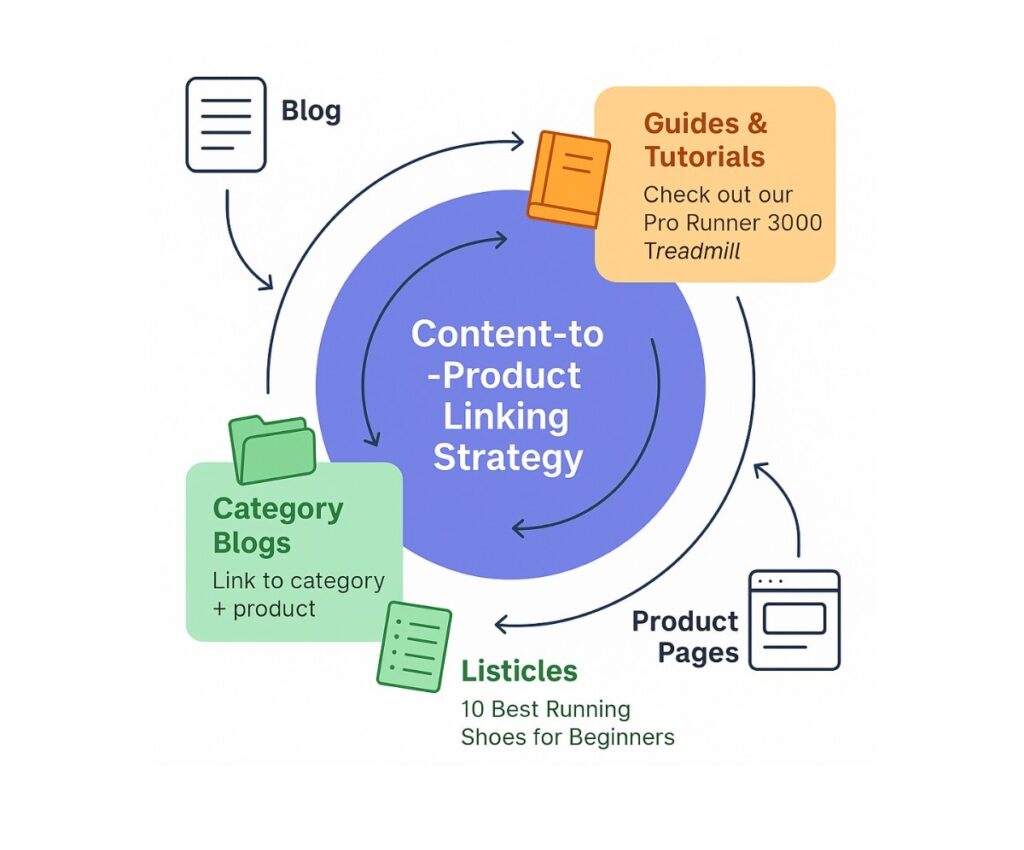
Category pages should provide crawlable links to products that belong within that category.
Google directly warns that products reachable only through an internal search box may not be discovered through normal crawling because Googlebot generally does not submit searches into site search forms.
That makes category architecture one of the most important crawl-depth controls.
Check whether:
- Product cards contain normal crawlable
<a href>links. - Products are available without requiring site search.
- Important products appear before excessive pagination.
- JavaScript does not hide essential product links.
- Products remain linked when merchandising rules change.
Category pages should function as discovery hubs, not simply visual product grids.
Use Subcategories to Flatten Large Catalogs
Removing subcategories is not always the best way to reduce crawl depth.
On large stores, useful subcategories can shorten the path to groups of highly relevant products.
For example:
Homepage → Shoes → Running Shoes → Product
may be stronger than placing 4,000 shoe products directly inside one category.
A useful hierarchy organizes inventory around real customer demand.
The architecture should become shallower where useful, not simply flatter everywhere.
Add Contextual Links to Priority Products
Navigation is only one source of internal links.
Important products can also receive relevant links from:
- Buying guides
- Comparison articles
- Brand pages
- Related-product modules
- Popular-product sections
- Collection pages
- Seasonal landing pages
- Product alternatives
- Complementary-product sections
Context matters.
A link from a guide about trail running shoes to a relevant trail shoe gives users and search engines a meaningful connection between the two pages.
This also creates additional discovery routes if the normal category path becomes deeper.
Control Faceted Navigation Before It Consumes Crawl Paths
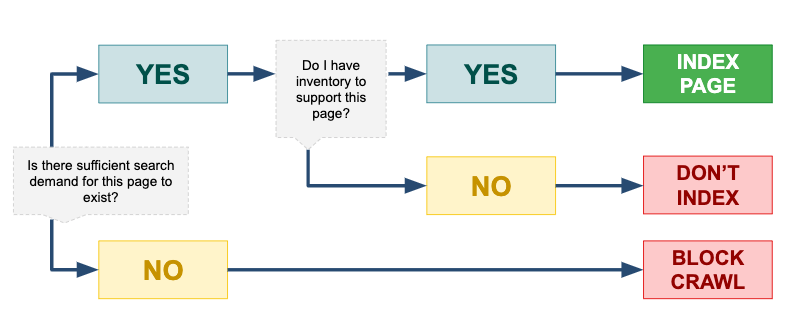
Faceted navigation can create thousands or millions of combinations involving color, size, price, brand, material, sorting, and availability.
Without controls, crawlers can spend significant resources following low-value parameter combinations instead of reaching important products.
Google warns that ecommerce URL structures can create crawling inefficiencies when large numbers of unnecessary URLs are generated.
A clear set of parameter URL controls can prevent filters from dominating the crawl graph.
Decide Which Facets Deserve Search Visibility
Use a simple decision framework.
| Facet Type | Typical SEO Treatment | Reason |
|---|---|---|
| High-demand category + attribute | Consider indexable landing page | Can satisfy search demand |
| Sort order | Usually avoid indexing | Little unique search value |
| Tracking parameter | Consolidate or remove | Creates duplicate paths |
| Session parameter | Prevent unnecessary crawling | Generates duplicate URLs |
| Multiple low-value filters | Restrict carefully | Can create crawl traps |
| Useful brand/category combination | Evaluate individually | May have commercial demand |
Do not block parameters without understanding the effect.
Incorrect robots.txt ecommerce rules can stop crawling while leaving other indexing or canonicalization problems unresolved.
Fix Pagination That Hides Deep Products
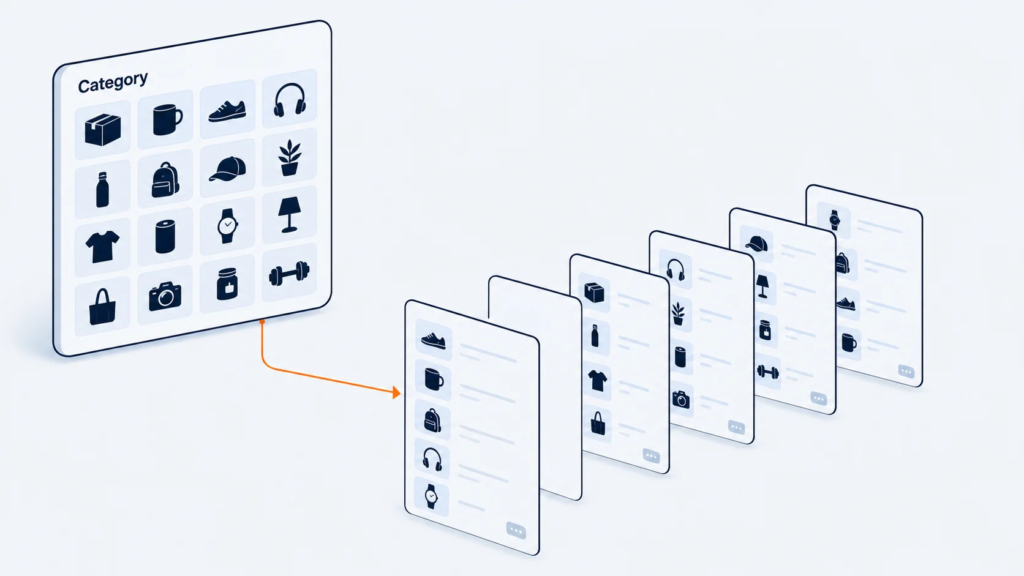
Large categories often spread products across many paginated pages.
Products on page 15 naturally require more crawl steps if each page only links to the next page.
Avoid pagination structures where crawlers must follow:
Page 1 → Page 2 → Page 3 → Page 4 → Page 5
before discovering later inventory.
Useful improvements may include stronger pagination navigation, subcategories, additional category segmentation, and contextual product links.
The correct solution depends on catalog size and platform limitations.
Find and Fix Orphan Product Pages
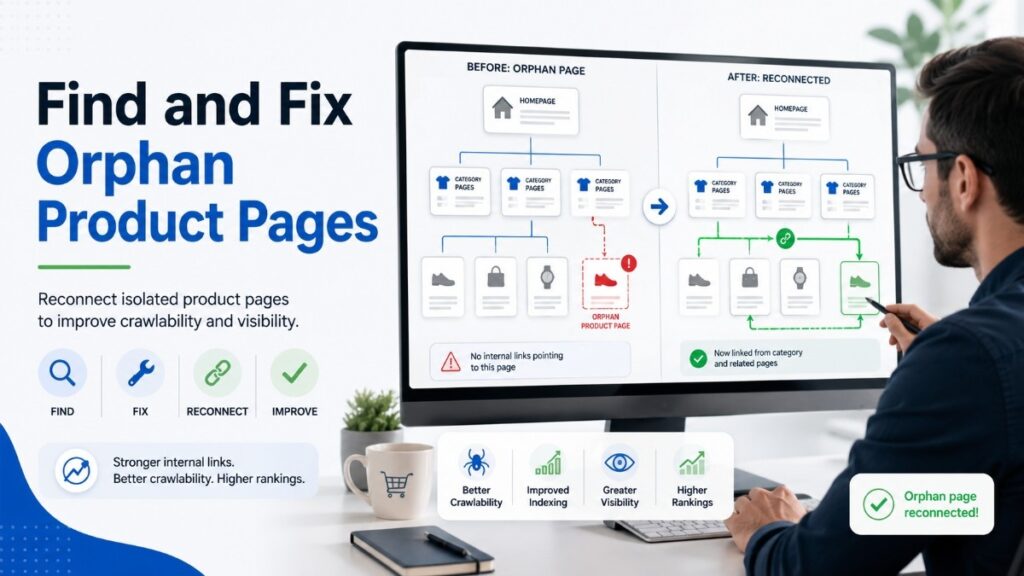
An orphan product has no crawlable internal link pointing to it.
These URLs may still appear in an XML sitemap, analytics platform, Merchant Center feed, or Search Console.
But sitemap inclusion does not create the same site-architecture relationship as internal linking.
Google recommends using sitemaps when comprehensive internal product linking is not possible, but also strongly recommends linking to products you want indexed.
Compare your crawler data against:
- XML sitemap URLs
- Google Search Console URLs
- Analytics landing pages
- Merchant Center products
- Product database exports
Any valuable product missing from the crawl deserves investigation.
Do Not Expect XML Sitemaps to Fix Crawl Depth
An XML sitemap helps search engines discover URLs and understand which pages you consider important.
It does not change the internal click path from the homepage.
If a product is six internal steps deep, adding it to an XML sitemap does not make it a depth-two product.
Use sitemaps for discovery support.
Use internal architecture to improve crawl paths, relevance relationships, and internal link distribution.
Watch Product Lifecycle Changes
This is one of the most overlooked ecommerce crawl-depth problems.
A product can start with strong internal links and gradually become buried when:
- A promotion ends.
- It disappears from bestseller modules.
- A category is reorganized.
- Inventory temporarily reaches zero.
- New products push it deeper into pagination.
- Seasonal navigation is removed.
Crawl depth is therefore not a one-time audit metric.
Stores with frequently changing inventory should monitor important product groups after major merchandising or navigation changes.
Re-Crawl After Internal Linking Changes
Never assume an architecture fix worked because links were added.
Run another crawl and compare the results.
Check whether:
- Priority product depth decreased.
- Internal inlinks increased.
- Orphan products disappeared.
- Parameter crawling decreased.
- Redirect chains were removed.
- Important products remain indexable.
- New navigation did not create duplicate URLs.
A broader ecommerce technical SEO audit can then connect crawl findings with canonicals, index coverage, rendering, structured data, page performance, and template issues.
Crawl Depth and Google AI Search Visibility
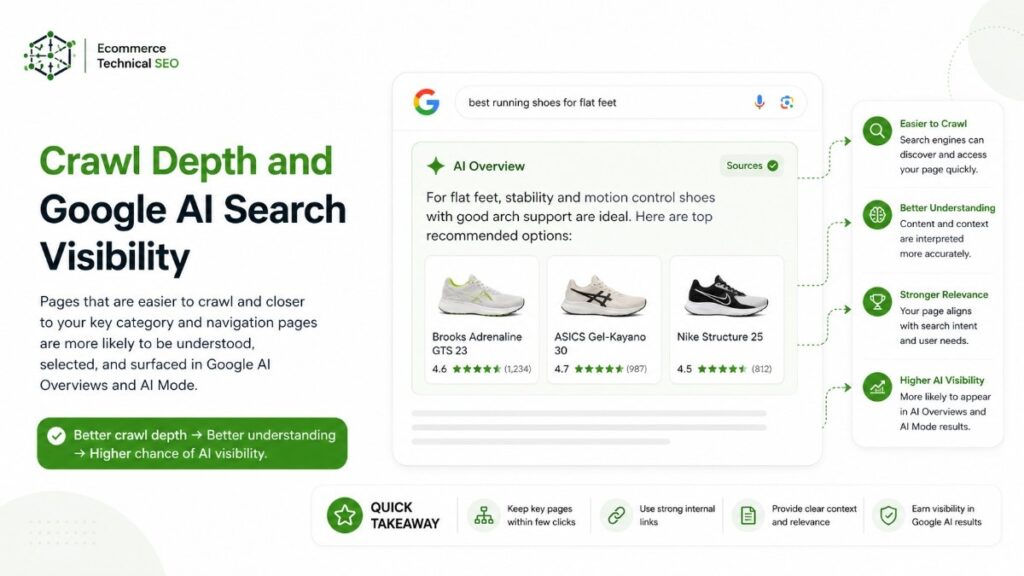
Google says AI Overviews and AI Mode can use query fan-out, where multiple related searches are performed across subtopics and data sources. Pages still need to be crawlable, indexed, and eligible for Google Search before they can appear as supporting links.
That makes basic ecommerce architecture relevant beyond traditional blue-link rankings.
For important products, focus on:
- Reliable crawl discovery
- Clear category relationships
- Descriptive internal anchors
- Useful product information
- Correct indexability
- Accurate structured data
- Merchant Center consistency
Do not create dozens of thin pages just to target possible AI sub-queries. Google specifically recommends useful, original content rather than scaled pages created around every possible search variation.
Frequently Asked Questions About Product Crawl Depth
How many clicks should a product page be from the homepage?
There is no fixed Google three-click requirement.
For high-priority products, aim for a short and logical path through important categories while also providing relevant contextual links.
Business value should determine how aggressively you reduce depth.
Does a sitemap reduce crawl depth?
No.
A sitemap can help search engines discover important URLs, but it does not change how many internal links must be followed from the homepage to reach the product.
Can robots.txt improve crawl depth?
Not directly.
Robots.txt can control access to certain crawl paths, but it does not create stronger internal links to products.
Use it carefully as part of broader crawl management rather than as a substitute for architecture.
Is crawl depth the same as crawlability?
No.
Crawl depth describes how far a page sits within the link architecture.
Crawlability describes whether search engines can access and follow the URL.
A product can be shallow but blocked, or crawlable but deeply buried.
Should every ecommerce product have the same crawl depth?
No.
Best sellers, strategic products, high-margin SKUs, and major seasonal inventory normally deserve stronger internal visibility than low-demand or discontinued inventory.
Prioritize crawl paths according to SEO and commercial importance.
Run a Screaming Frog Audit Before Scaling Ecommerce SEO
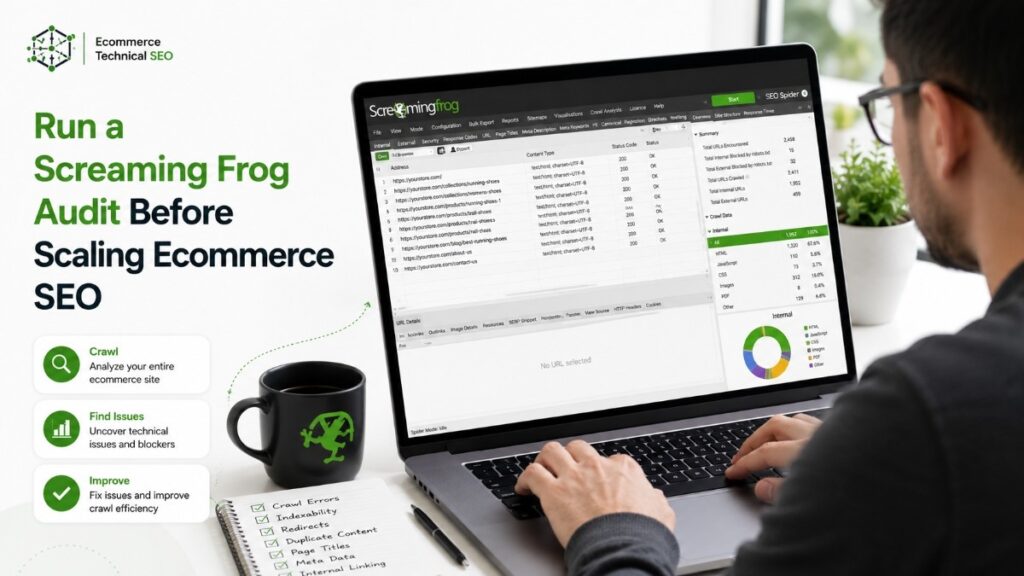
Before investing more budget into content or backlinks, crawl your store and confirm that search engines can efficiently reach the product pages that generate revenue.
A proper audit should review crawl depth, internal links, orphan URLs, pagination, faceted navigation, canonicals, robots directives, redirects, XML sitemaps, and indexability.
E-commerce Technical SEO helps ecommerce store owners, marketing teams, developers, and agencies turn Screaming Frog crawl data into practical technical SEO priorities. The focus is not improving a crawler score. It is improving product discovery, index coverage, rankings, and organic growth.
A focused technical SEO audit process can identify which products are buried, why their crawl paths became weak, and which template or internal-linking changes should be prioritized first.
Our technical SEO specialists work specifically around ecommerce challenges including crawlability, indexation, architecture, product pages, duplicate URLs, structured data, and platform limitations.
Run the crawl before scaling SEO. Make sure your highest-value products are easy for search engines to find before spending more to promote them.